Vietnam’s Cashew Paradox: Processing Dominance, Raw Material Dependency, and the Sustainability Imperative
Introduction
Vietnam occupies a structurally unique and strategically pivotal position in the global cashew value chain. As the world’s undisputed processing hegemon, Vietnam accounts for approximately 60–70% of global cashew kernel output and over 80% of all processed kernel exports — a concentration of industrial capability with few parallels in global commodity markets. In 2024, Vietnam exported roughly 730,000 tonnes of cashew kernels valued at $4.3 billion, cementing its role not merely as an agricultural exporter, but as the de facto manufacturing backbone of a $10 billion global industry. The Vietnam cashew market is projected to grow from $4.8 billion in 2024 to $6.4 billion by 2029, implying a compound annual growth rate of approximately 5.8%.
Yet beneath this veneer of export dominance lies a set of structural vulnerabilities that challenge the long-term resilience of the sector. Vietnam’s processing supremacy is built overwhelmingly on imported raw cashew nuts (RCN) — primarily sourced from West Africa and Cambodia — rather than on domestic agricultural production. This dependency, combined with rapidly escalating raw material costs, eroding processing margins, and mounting pressure from global buyers and regulators on environmental, social, and governance (ESG) compliance, represents a fundamental strategic risk that is simultaneously systemic and under-acknowledged.
Sustainability in the cashew sector is not simply a reputational concern for brands seeking green credentials. It is increasingly a structural constraint on market access, supply reliability, and long-term investment viability. The convergence of the EU Deforestation Regulation (EUDR), corporate net-zero commitments, and the global living income agenda is fundamentally reordering the rules of competition in commodity agriculture. For an industry as concentrated and trade-dependent as Vietnamese cashew processing, these shifts are not peripheral — they are existential. This report provides a rigorous, data-driven analysis of the sustainability landscape in the global and Vietnamese cashew sector, culminating in a deep-dive examination of the industry’s most critical and under-recognized structural risk: Vietnam’s deepening dependency on imported raw cashew nuts and the cascading ESG, economic, and geopolitical vulnerabilities this dependency generates.
Overview of Sustainability in the Global and Vietnamese Cashew Industry
The ESG Landscape: A Sector in Transition
The global cashew industry spans more than 40 producing countries, engages an estimated 3 million smallholder farmers — primarily in Sub-Saharan Africa — and serves consumer markets in North America, Europe, China, and the Middle East. Despite generating billions of dollars in annual trade value, the sector is characterized by profound structural inequalities, fragmented governance, and a persistent disconnect between where economic value is created and where it is captured. Across all three ESG dimensions, the industry faces challenges that are growing in regulatory and commercial urgency.
Environmental Dimension
Cashew cultivation is concentrated in tropical and sub-tropical agroecological zones highly sensitive to climate variability. In West Africa — the world’s primary RCN production region, accounting for approximately 60% of global supply — irregular rainfall, prolonged dry spells, and shifting seasonal patterns are already reducing yields and increasing intra-season price volatility. Côte d’Ivoire alone produced a record crop of approximately 1.04 million metric tonnes of RCN in recent seasons, yet climate models project increasing weather instability across the Sahel and humid tropical zones that will compress productive windows. In Vietnam, the domestic cashew cultivation area has contracted sharply, falling from a peak of 440,000 hectares in 2007 to approximately 305,000 hectares by 2024 — a 31% reduction driven by land competition with higher-value crops such as durian, pepper, and rubber. Domestically produced RCN now meets only 10–12% of Vietnam’s processing demand. Beyond land-use contraction, the cashew processing industry generates significant by-product streams — including cashew nut shell liquid (CNSL) and testa — whose valorization remains largely opportunistic and fragmented rather than systematically circular, representing both an environmental inefficiency and an untapped economic opportunity.
Social Dimension
The social dimension of cashew sustainability is dominated by the income equity question. An estimated 3 million smallholder farmers across Africa, India, and Southeast Asia earn their primary livelihoods from cashew production, yet their share of the final consumer price is structurally constrained by information asymmetries, weak bargaining power, and multiple layers of intermediation. Research from Côte d’Ivoire — the world’s largest RCN producer — indicates that farmers have historically received approximately 51% of the world market reference price, falling short of the 60% benchmark that national policy frameworks have sought to guarantee. In practice, real farm-gate returns fluctuate significantly with international price cycles, and many smallholder households remain below living income thresholds. Labor conditions in processing, particularly in Vietnam’s Binh Phuoc province — home to nearly 300 processing companies — have also drawn scrutiny, with concerns around occupational health risks from CNSL exposure, wage adequacy, and the increasing informalization of sub-contracted peeling labor. Traceability across multi-origin supply chains remains severely limited, making it difficult for global buyers to verify social compliance claims at the farm level.
Economic Dimension
The economic sustainability of the cashew value chain is characterized by asymmetric margin distribution, structural price volatility, and a processing model increasingly exposed to input cost inflation. At the farm level, raw cashew nut production yields margins of approximately 10–15%, constrained by high logistics costs, climate risk, and limited access to inputs and credit. At the processing level, margins of 25–40% are theoretically achievable, but Vietnamese processors in particular are experiencing significant compression: in 2025, Vietnam imported 2.6 million tonnes of RCN worth $4.01 billion through October alone, with average import prices rising 21% to $1,523 per tonne, while kernel export values grew more slowly, narrowing the trade surplus to historically thin levels. At the retail end, margins of 30–50% — particularly for organic and premium products — are captured almost entirely by brands and retailers in destination markets, with minimal reinvestment in upstream supply chain resilience. This asymmetry is not simply a distributional concern; it represents a structural fragility that destabilizes investment across the entire value chain.
Vietnam’s Positioning in the Global Value Chain
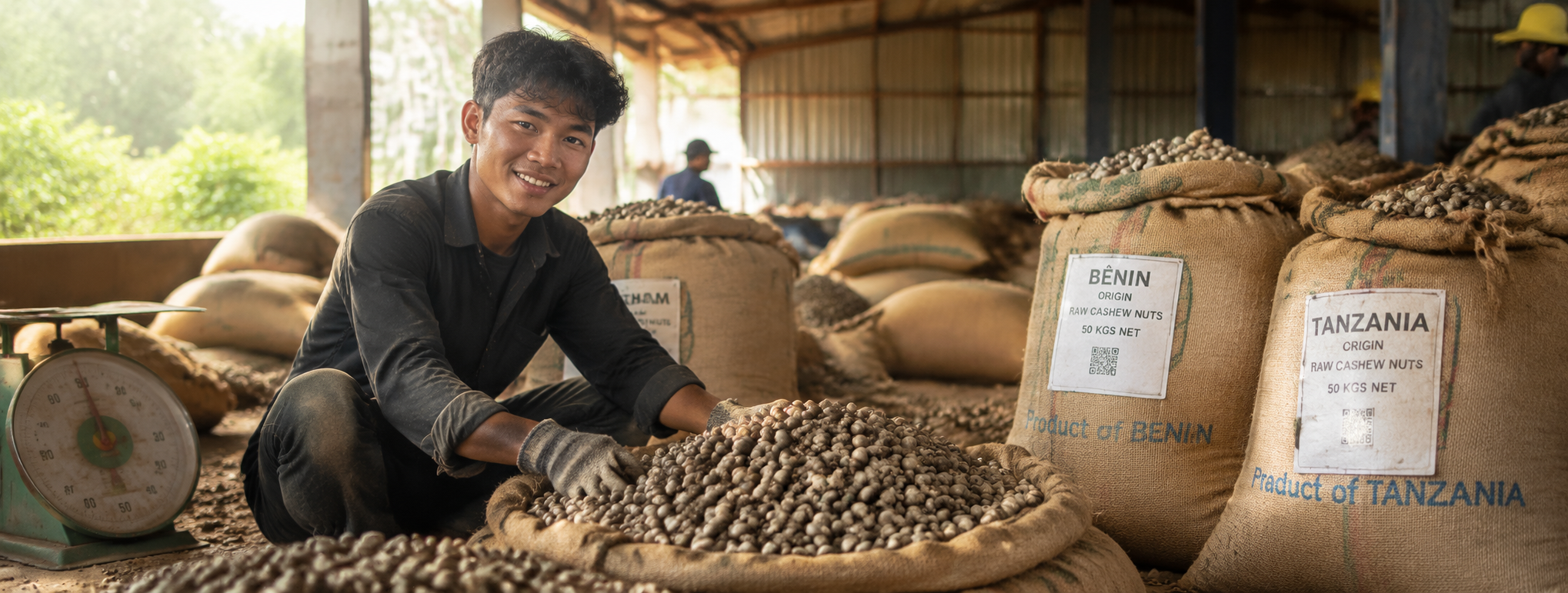
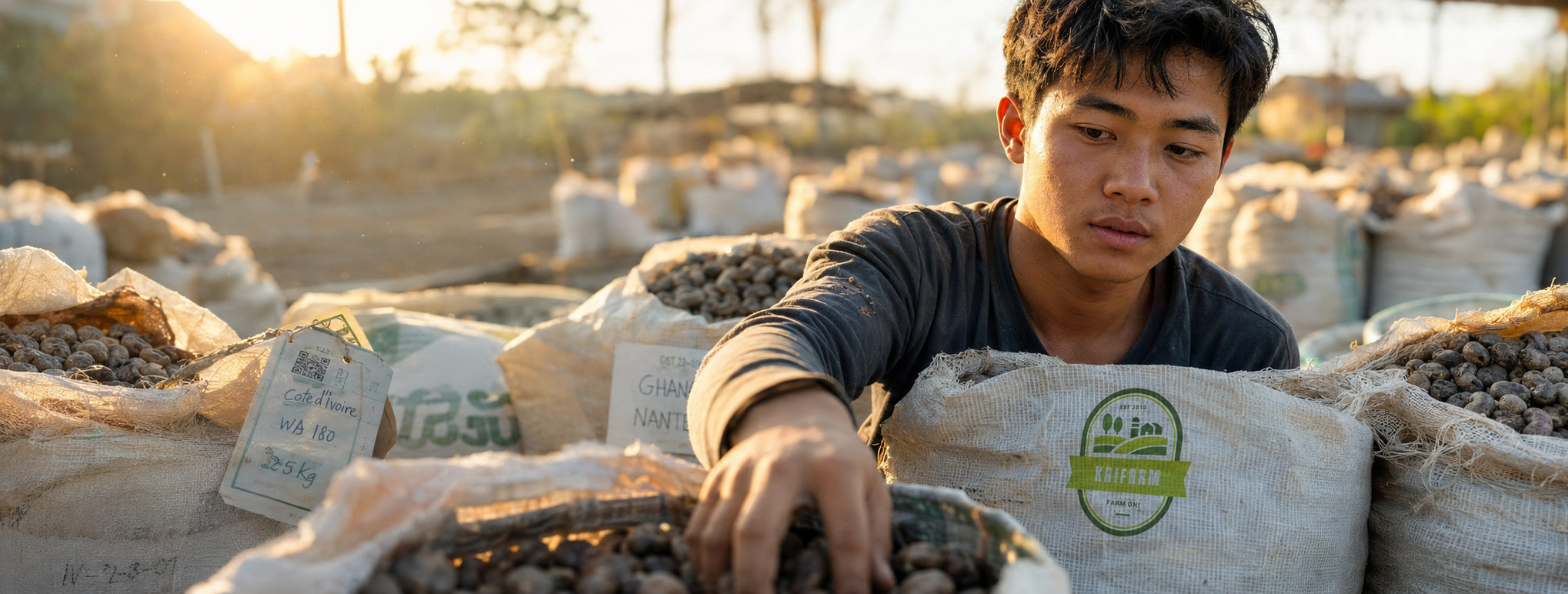
Vietnam’s position in the global cashew value chain is best understood through the lens of a processing hub operating at structural tension: world-class in manufacturing efficiency, yet fundamentally dependent on external raw material flows it cannot fully control. The country processes more than 90% of its cashew output for re-export, sourcing the vast majority of its RCN from West Africa (principally Côte d’Ivoire, Nigeria, Ghana, and Tanzania) and Cambodia. This triangular trade architecture — African and Cambodian raw nuts, Vietnamese processing, Western and Chinese consumption — has created extraordinary export scale but also extraordinary supply chain fragility. The EU-Vietnam Free Trade Agreement (EVFTA), implemented in 2020, accelerated Vietnamese kernel exports to Europe, but simultaneously raised the compliance bar: EU buyers increasingly demand sustainability certifications, deforestation-free supply chains, and living wage documentation that Vietnam’s fragmented, multi-origin import model struggles to provide.
Key Trends and Data Insights
Production and Trade Flow Dynamics
Global cashew production is dominated by West Africa, which supplies approximately 60% of all RCN. Côte d’Ivoire — by far the largest single producer — shipped approximately 780,000 metric tonnes of RCN to Vietnam in the first seven months of 2024 alone, with full-year volumes approaching or exceeding 1 million tonnes. Nigeria, Ghana, Tanzania, and Benin collectively add hundreds of thousands of additional tonnes. Cambodia has emerged as the second pillar of Vietnam’s raw material supply: in 2025, nearly 1.0 million metric tonnes of Cambodian RCN were exported to Vietnam in the first ten months, worth approximately $1.47 billion, with 95–98% of Cambodia’s annual RCN production flowing directly to Vietnamese processors. Vietnam’s domestic RCN output, by contrast, has stagnated at approximately 340,000–370,000 tonnes per year — representing roughly 12–13% of total processing demand.
On the export side, Vietnam’s kernel exports reached approximately 730,000 tonnes in 2024, valued at $4.3 billion — a 15.2% volume increase and 20.6% value increase over the prior year. The EU accounts for approximately 26% of Vietnam’s kernel exports by volume, the United States for approximately 24%, and China for approximately 8%. The US market experienced a significant setback in early 2025, with a 10% import tariff on Vietnamese cashews reducing US-bound volume by an estimated 26% in the first quarter of 2025 — illustrating how geopolitical and trade policy risks can translate rapidly into revenue shocks for a processing industry that has limited pricing power and thin margins.
Structural Imbalances and Emerging Pressures
Several structural imbalances define the contemporary cashew landscape and are likely to intensify over the 2025–2035 period.
First, the processing geography is shifting. African producing countries — most notably Côte d’Ivoire, Benin, and Ghana — are aggressively investing in domestic processing capacity. Côte d’Ivoire’s installed processing capacity expanded from 68,515 tonnes in 2015 to approximately 350,000 tonnes by 2024, a five-fold increase, with utilization rates approaching 98%. Kernel exports from Côte d’Ivoire reached 72,000 tonnes in 2024, more than five times the 2020 volume. Benin imposed a complete ban on raw cashew exports in April 2024 to channel all RCN into its new Glo-Djigbé Industrial Zone (GDIZ). While implementation has been imperfect — mid-season bans tend to create smuggling and market volatility rather than clean supply redirection — the directional signal is unambiguous: African governments are no longer willing to perpetually export raw materials for value capture elsewhere.
Second, the competitiveness gap between Vietnamese and African processing is narrowing. The cost advantage of Vietnamese processors over West African facilities is estimated at $150–350 per tonne of RCN, driven by mechanization, economies of scale, and proximity to Southeast Asian logistics networks. However, as African processors receive international development funding, technology transfer, and policy support, and as Vietnamese labor costs rise while rural demographic shifts constrain workforce expansion, this gap will narrow progressively. The mechanization of kernel processing in Côte d’Ivoire, supported by companies such as Valency and Robust International, is already demonstrating that origin processing is economically viable at scale.
Third, ESG-driven buyer preferences are reshaping procurement. Global snack brands scaled cashew purchases from Vietnam by 8% in H1 2025, driven by plant-based and vegan product lines. However, European retailers are simultaneously demanding traceability, sustainability certifications, and deforestation-free sourcing as preconditions for supply chain access. The EUDR, combined with the UK’s Environment Act and evolving US supply chain due diligence requirements, is creating a compliance architecture that small and medium Vietnamese processors — many of which source from dozens of unverified African origins — are ill-equipped to meet.
Benchmark Comparison: Vietnam vs. Key Competitors
| Indicator | Vietnam | India | Côte d’Ivoire | Brazil |
|---|---|---|---|---|
| Share of global kernel exports | ~80% | ~8–10% | ~5–7% (rising) | <2% |
| Domestic RCN self-sufficiency | ~12–13% | ~60–65% | ~100% (net exporter) | ~100% (net exporter) |
| Processing capacity (est. MT) | ~3.0 million MT/yr | ~1.5 million MT/yr | ~430,000 MT/yr (2025) | ~150,000 MT/yr |
| Processing margin pressure | High (import-cost exposed) | Moderate (domestic RCN buffer) | Low (vertically integrated) | Low (domestic supply) |
| Traceability capability | Low–Medium | Medium | Medium (improving rapidly) | Medium–High |
| ESG compliance readiness | Developing | Developing | Improving with investment | Moderate |
Deep Dive: Vietnam’s Structural Dependency on Imported Raw Cashew Nuts — A Multi-Dimensional Supply Chain Risk
Framing the Issue
Of all the sustainability challenges facing Vietnam’s cashew industry, none is more structurally consequential — and yet more systematically under-addressed — than the country’s near-total dependency on imported raw cashew nuts. This is not merely an agricultural policy shortcoming or a logistics optimization challenge. It is a systemic vulnerability that simultaneously exposes Vietnam’s processing sector to raw material price shocks, geopolitical supply disruptions, ESG compliance failures, and a gradual erosion of competitive advantage as origin-country processing capacity matures. Understanding this dependency requires moving beyond the surface-level narrative of Vietnam as a processing success story and interrogating the structural architecture that makes this success fragile.
In 2025, Vietnam processed approximately 2.8–3.0 million metric tonnes of RCN — of which only 340,000–370,000 tonnes, or roughly 12–13%, were sourced domestically. The remaining 87–88% was imported, primarily from Côte d’Ivoire, Nigeria, Ghana, Tanzania (via Africa) and Cambodia. This ratio has worsened steadily over the past two decades: in 2007, Vietnam’s domestic cashew area stood at 440,000 hectares; by 2024, it had contracted to approximately 305,000 hectares, as farmers switched to durian, pepper, and other higher-income alternatives. The trajectory is one of accelerating external dependency at the very moment that external supply conditions are becoming more volatile, more expensive, and more politicized.
Why This Issue Is Critical and Under-Recognized
The conventional narrative in industry and policy circles frames Vietnam’s import dependency as a manageable trade feature — a country that adds value through processing rather than primary production, not unlike Taiwan in semiconductors or Germany in automotive. This analogy is superficially appealing but analytically misleading. Unlike high-technology manufacturing, cashew processing is a low-margin, commodity-grade transformation activity with limited proprietary technology, thin differentiation, and minimal switching costs for global buyers. The “value addition” Vietnam performs — mechanical shelling, grading, and packaging — is increasingly replicable by origin countries with far lower input costs and shorter supply chains. Vietnam’s processing advantage is thus not structural in the way that advanced manufacturing is structural; it is contingent on a cost-arbitrage gap that is actively being closed from below.
Moreover, the dependency creates a paradox at the heart of Vietnam’s ESG positioning. To satisfy European and North American buyers demanding deforestation-free, traceable, and ethically sourced cashews, Vietnamese processors must be able to document the provenance, land-use history, and labor conditions of raw nuts sourced from hundreds of smallholder farmers across dozens of supply chain tiers in multiple African countries — a task for which the current industry architecture is almost entirely unprepared. The 800 enterprises involved in annual cashew import and export in Vietnam include 100–200 importers, the majority of which are small-scale companies handling less than 10,000 tonnes per year, sourcing from informal brokers and traders across West Africa with no systematic traceability infrastructure.
Root Causes and Systemic Challenges
Economic Drivers of Domestic Supply Contraction
The decline of Vietnam’s domestic cashew cultivation is fundamentally driven by comparative income economics at the farm level. Durian — now Vietnam’s most valuable agricultural export — generates gross revenues of $15,000–25,000 per hectare in premium years, compared to cashew’s $800–1,500 per hectare. Pepper, dragon fruit, and rubber have similarly outcompeted cashew on a per-hectare income basis in the Southeast and Central Highlands provinces that historically defined Vietnam’s cashew belt. Without direct subsidy support, input cost reduction, or significant yield improvement, the rational smallholder decision in Vietnam is to uproot cashew trees and plant higher-value alternatives. VINACAS (Vietnam Cashew Association) has called for policy intervention to stabilize the domestic cultivation area, but without credible income parity interventions, further contraction is probable.
Geopolitical and Policy Risks in African Supply Countries
Vietnam’s dominant African suppliers — Côte d’Ivoire, Nigeria, Ghana, Benin, and Tanzania — are pursuing increasingly active industrial policies designed to capture more value from their cashew endowments domestically. This trend is not merely rhetorical. Benin’s April 2024 ban on raw cashew exports, directed at feeding its new GDIZ industrial zone, represents one end of the policy spectrum. Côte d’Ivoire, while currently allowing the bulk of RCN to flow to Vietnam and India, has set an explicit strategic objective of processing at least 50% of its national crop domestically by 2030. Ghana’s Tree Crops Development Authority introduced minimum producer prices and an export permit system for unprocessed cashews in 2023–2025. Multiple governments are also imposing or tightening export taxes on RCN — ranging from $30 to $180 per tonne — to incentivize domestic processing investment. The competitive cost advantage of Vietnamese processors over West African facilities, estimated at $150–350 per tonne of RCN, is therefore facing a sustained policy-driven erosion from the supply side, even before accounting for labour cost inflation in Vietnam and technology transfer to Africa.
Cambodia’s Dual Role: Complementary Supplier and Structural Risk
Cambodia has become Vietnam’s second critical RCN supply pillar, providing nearly 1.0 million metric tonnes in 2025 — approximately 35–40% of total Vietnamese imports by volume. The Cambodia-Vietnam cashew relationship benefits from geographic proximity, zero export tariffs (Cambodia is one of only two major RCN exporters without an export tax), and deeply integrated supply chain relationships. However, this reliance creates its own risks. Cambodia’s RCN exports to Vietnam have shown extreme volatility — rising from approximately 150,000 tonnes in 2018 to a peak of over 1 million tonnes in 2021, before dropping sharply in 2022–2023 due to African supply dynamics and Vietnamese processing capacity fluctuations. Climate events in Cambodia’s cashew-producing regions (primarily Kampong Speu and Kampot provinces) have direct and rapid consequences for Vietnamese processing volumes and margins. Furthermore, any policy shift by the Cambodian government toward domestic processing promotion — following the Benin or Côte d’Ivoire model — could rapidly remove a critical volume pillar from Vietnam’s supply architecture.
The ESG Compliance Gap in Multi-Origin Import Chains
Vietnam’s raw material import architecture creates a structural ESG compliance gap that is growing in commercial and regulatory significance. The EU’s Deforestation Regulation (EUDR) requires operators placing relevant commodities on the EU market to conduct geolocation-level due diligence on land-use change. While cashews are not currently listed as a regulated commodity under EUDR, the regulation’s framework is widely anticipated to expand, and major EU buyers are proactively requiring deforestation-free certification as a contractual precondition. Additionally, the EU Corporate Sustainability Due Diligence Directive (CSDDD) will require large companies to identify and address human rights and environmental impacts across their full supply chains — directly implicating Vietnamese processors supplying EU-listed brands. Vietnam’s fragmented, multi-origin import model — in which RCN from dozens of smallholder-dominated origins in West Africa passes through multiple broker layers before reaching Vietnamese factories — makes farm-level traceability practically impossible under current commercial structures.
The Margin Compression Trap
The economic arithmetic of Vietnam’s processing model is increasingly unfavorable. In 2025, raw material imports through October reached $4.01 billion against kernel exports of $4.25 billion — a trade surplus of only $240 million on a throughput value of over $8 billion. After accounting for labor, energy, logistics, financing, and overhead costs, net processing margins across the industry are estimated to be in the range of 5–10% on revenue, with many smaller processors operating at or near breakeven during periods of RCN price spikes. The 21% rise in average RCN import prices in 2025 (to $1,523/tonne) against more modest growth in kernel export prices illustrates the structural squeeze: Vietnam bears all the commodity price risk of raw material procurement, while global buyers — who set the kernel price and control the consumer interface — capture the majority of value added in roasting, branding, and retail distribution.
Impacts on Stakeholders
African Smallholder Farmers
For the estimated 3 million smallholder cashew farmers in Africa — including 350,000 in Côte d’Ivoire and nearly 200,000 in Benin alone — Vietnam’s processing dominance has historically constrained their ability to capture value beyond the farm gate. Because 85–90% of African RCN is exported unprocessed to Vietnam and India, the economic value of the shelling, grading, and conditioning process is created and retained abroad. Smallholder farm-gate prices are directly exposed to Vietnamese and Indian processor demand cycles, with limited price discovery transparency. Research indicates that Ivorian farmers receive approximately 51% of the world market reference price — below the 60% benchmark that government policy targets. The combination of low and volatile farm-gate prices, limited access to credit and inputs, and no participation in downstream value chains keeps most smallholder cashew households below living income thresholds. Paradoxically, as African processing capacity grows and governments restrict RCN exports, smallholder farmers in origin countries may benefit — but only if domestic processor margins are sufficient to sustain competitive farm-gate prices, which remains uncertain given Africa’s infrastructure and capital cost disadvantages.
Vietnamese Processors and Exporters
Vietnamese processors face a compounding set of structural risks that collectively threaten the long-term viability of the current processing model. In the near term, margin compression from rising RCN import costs — exacerbated by African export restrictions, Cambodian supply volatility, and shipping rate increases — is the most acute challenge. In the medium term, the gradual repatriation of processing activity to origin countries, combined with China’s development of superior processing technologies (now beginning to challenge Vietnam’s traditional mechanization advantage), threatens to erode the competitive moat that has sustained Vietnam’s market dominance. In the long term, ESG compliance costs — required to maintain access to EU and US premium markets — will fall disproportionately on Vietnamese processors, who must invest in traceability systems, sustainability certifications, and supply chain audits across supply networks they do not control and cannot easily restructure without significant capital investment and long-term sourcing partnerships. Vinacas estimates that without fundamental structural solutions, Vietnam risks losing its position as the global processing hub to a combination of origin-country processors and emerging competitors including China and the Middle East.
Global Buyers and Brands
For international snack brands, food manufacturers, and retailers — who collectively capture 30–50% margins in consumer markets — Vietnam’s structural dependency creates both sourcing risks and ESG liability exposure. Heavy concentration of global kernel supply in a single processing geography (Vietnam) means that any systemic shock — whether from geopolitical disruptions to African RCN supply, Vietnamese regulatory changes, climate impacts on key producing regions, or trade tariff escalations — can propagate rapidly across global cashew supply chains. The 10% US tariff on Vietnamese cashews introduced in 2025, which reduced US import volumes by approximately 26% in the first quarter, provides a recent illustration of this concentration risk. Additionally, as consumer-facing ESG reporting requirements intensify — particularly under the EU’s Corporate Sustainability Reporting Directive (CSRD) and US SEC climate disclosure rules — brands sourcing through Vietnamese processors with opaque, multi-origin supply chains face growing reputational and regulatory exposure. The inability to document farm-level social and environmental conditions in African sourcing regions is increasingly a commercial liability, not merely a reputational one.
Strategic Recommendations
For Vietnamese Processors and Exporters
- Invest in vertical supply chain integration in Africa: Leading Vietnamese processors should move beyond transactional RCN purchasing toward long-term structured procurement partnerships with African cooperatives, aggregators, and farmer organizations. This means establishing field offices or joint ventures in key origin countries — Côte d’Ivoire, Ghana, Nigeria — that can provide pre-financing, agronomic support, and traceability data collection at the farm level. The cost of supply chain restructuring is high, but the cost of losing market access to ESG-non-compliant sourcing is higher. A 5–10 year horizon investment of $50–100 million in African supply chain infrastructure would yield structural resilience that no amount of domestic processing efficiency improvement can replicate.
- Accelerate digital traceability adoption: Adoption of blockchain-enabled or GPS-based traceability platforms — already deployed at pilot scale by companies such as Olam and Pinduoduo-backed agri-tech firms — should be fast-tracked across Vietnamese processor supply chains. Investment in traceability is not merely a compliance cost; it is a market access precondition for the EU premium segment and an increasingly important differentiator for contract renewals with major global brands. VINACAS should coordinate industry-wide adoption of interoperable traceability standards to reduce per-unit compliance costs through shared infrastructure.
- Shift product mix from commodity kernels to value-added formats: Vietnam’s current export mix remains heavily weighted toward bulk kernels (WW240, WW320 grades), which are the most price-sensitive and margin-thin product categories. Aggressive expansion into roasted, flavored, organic-certified, and retail-packaged formats — combined with co-branding partnerships with Western and Chinese food companies — can capture significantly higher margins and reduce exposure to commodity price cycles. Premium-grade penetration is already accelerating: W180 kernel exports rose 92.8% in 2024–2025, indicating strong demand for higher-quality tiers that command better prices.
- Diversify raw material supply geographically and contractually: Over-reliance on Côte d’Ivoire and Cambodia as dominant supply pillars creates concentration risk that can be partially mitigated through structured forward purchasing agreements with a broader range of origin countries, including Tanzania, Mozambique, Indonesia, and India. Long-term off-take contracts with supply-side price floors and quality premiums can provide mutual stabilization for both processors and farmers.
For African Smallholder Farmers and Producer Organizations
- Invest in yield improvement and orchard renovation: Average cashew yields in West Africa remain significantly below agronomic potential — typically 300–600 kg/ha against a theoretical maximum of 1,500–2,000 kg/ha with improved varieties and management. Farmer organizations should prioritize mass distribution of improved, high-yielding, climate-adapted varieties developed by national research institutes (CNRA in Côte d’Ivoire, INRAB in Benin) alongside extension services that upgrade agronomic practices. Programs such as USDA’s PRO-Cashew project ($47.3 million, 2019–2024) have demonstrated that targeted investment can benefit over 700,000 individuals and generate $133 million in annual sales.
- Develop collective marketing and price transparency mechanisms: Fragmentation among smallholder sellers is the primary source of their weak bargaining power. Producer cooperatives with access to real-time RCN market price data — as operated through the Tanzanian Mercantile Exchange model — can negotiate collectively with buyers, reducing the information asymmetry that depresses farm-gate prices. Expansion of cooperative structures, warehouse receipt systems, and transparent price-posting mechanisms should be a priority for both farmer organizations and development finance institutions.
For International Buyers and Brands
- Commit to long-term sourcing partnerships with living income premiums: Global brands and retailers capturing 30–50% margins in consumer markets have both the financial capacity and the strategic obligation to redirect a portion of value chain surplus toward supply chain resilience. Concretely, this means moving from spot or short-term transactional procurement to 3–5 year supply agreements that include explicit living income premiums for smallholder farmers in origin countries, co-investment in traceability infrastructure, and joint ESG verification mechanisms. Companies such as Costco, Nestlé, and Aldi that have made public commitments to living wages in supply chains should extend these frameworks to cashew procurement.
- Diversify sourcing geography proactively: Reducing sourcing concentration in Vietnam — which currently supplies 80%+ of global processed kernels — is a business continuity imperative, not merely an ESG preference. Brands should actively develop direct sourcing relationships with emerging origin-country processors in Côte d’Ivoire, Benin, Ghana, and Tanzania, which offer shorter supply chains, improving traceability capabilities, and the additional reputational benefit of supporting African industrial development. This diversification strategy should be communicated transparently to consumers, who increasingly reward supply chain origin stories.
- Invest in ESG capacity building for tier-2 and tier-3 suppliers: The ESG compliance gap in Vietnamese processing is not purely a Vietnamese problem — it is a buyer problem too. Brands that have contractually transferred ESG audit requirements to first-tier Vietnamese processors without supporting the supply chain infrastructure needed to actually verify compliance downstream are exposed to the same regulatory and reputational risks they sought to avoid. Technical assistance funding for traceability systems, farmer training, and ESG audit capacity across the supply chain should be treated as a cost of doing business, not as philanthropy.
For Policymakers (Vietnam and International)
- Vietnam — Implement a domestic cashew cultivation incentive framework: Reversing the contraction of Vietnam’s domestic cashew area requires making cashew cultivation economically competitive with alternative crops. Policy options include: direct area-based subsidies for cashew replanting with high-yield varieties; guaranteed minimum farm-gate price programs for domestic RCN (modeled on Côte d’Ivoire’s intervention mechanisms); tax incentives for integrated cashew-processing enterprises that source a minimum percentage of RCN domestically; and investment in cashew agronomy research at provincial agricultural stations. A target of recovering 50,000–80,000 hectares of cashew cultivation over a 10-year horizon is directionally achievable with credible policy support.
- Vietnam — Establish a national cashew traceability standard and digital registry: The Ministry of Agriculture and Rural Development (MARD) and VINACAS should jointly develop a national cashew origin registry — covering both domestic production and imported RCN — that assigns digital lot identifiers to shipments from point of origin (African farm cooperative or Cambodian aggregator) through Vietnamese processing to final export. This infrastructure, which could be modeled on the EU’s TRACES system, would dramatically reduce per-unit ESG compliance costs for individual processors and position Vietnam as a globally trusted, traceable origin — a powerful commercial differentiator in premium markets.
- International — Align development finance with origin-country processing investment: Development finance institutions (IFC, AfDB, FMO, Proparco) should scale investment in African cashew processing infrastructure to a level commensurate with the sector’s strategic importance to agricultural development in West Africa. The current model — in which African countries produce 60% of the world’s cashew raw material while capturing only 10–15% of processed kernel value — is a developmental failure that perpetuates commodity dependency. A target of 50% local processing by 2035 for the top five African cashew producers is achievable with coordinated policy, infrastructure investment, and guaranteed off-take commitments from global brands.
Conclusion
Vietnam’s cashew industry stands at a structural inflection point. Two decades of relentless capacity expansion and processing efficiency investment have made Vietnam the undisputed center of gravity in the global cashew value chain — a position that has generated billions of dollars in export revenues, hundreds of thousands of industrial jobs, and a sophisticated logistics and processing infrastructure with few peers in global commodity agriculture. Yet the very architecture of this success — a processing model built on the mass import and transformation of raw materials sourced from fragmented, multi-origin, ESG-opaque African and Cambodian supply chains — contains the seeds of its own disruption.
The deep-dive analysis in this report has demonstrated that Vietnam’s structural dependency on imported raw cashew nuts is not a static feature of an otherwise sound industrial model, but a dynamic vulnerability whose risk profile is worsening across multiple dimensions simultaneously: raw material cost inflation, African origin-country processing competition, geopolitical supply disruptions, ESG compliance exposure, and the erosion of processing technology advantages to Chinese competitors. The margin arithmetic of 2025 — in which raw material imports absorbed over 94% of kernel export revenues — is a structural warning signal, not a cyclical anomaly.
The strategic imperative for Vietnam is clear but demands significant departures from the current operating model. Vertical integration into African supply chains, digital traceability investment, product mix premiumization, and a renewed policy commitment to domestic cultivation represent the four pillars of a resilient cashew sector capable of maintaining global leadership in a regulatory environment where ESG compliance is becoming as important as processing efficiency. For global buyers, the concentration risk of an 80% dependency on a single processing geography is a business continuity vulnerability that responsible procurement strategies must address through diversification, partnership, and genuine supply chain investment. For African producing countries and their smallholder farmers, the window of opportunity to capture a greater share of cashew value chain economics — through policy-driven processing industrialization and collective farmer empowerment — is open and narrowing.
The cashew industry’s next decade will be defined not by who shells the most nuts most efficiently, but by who controls the full architecture of a traceable, equitable, and climate-resilient supply chain. Vietnam has the industrial assets, the institutional knowledge, and — if policymakers and industry leaders act with sufficient urgency — the time to make that transition. The alternative is a gradual but irreversible erosion of the dominant position it has spent twenty years building.
James T Nguyen
Chairman, Chief Strategy Officer, and Chief Investment Officer – KAI Holding®
People
People
Story
Story
Story
Story