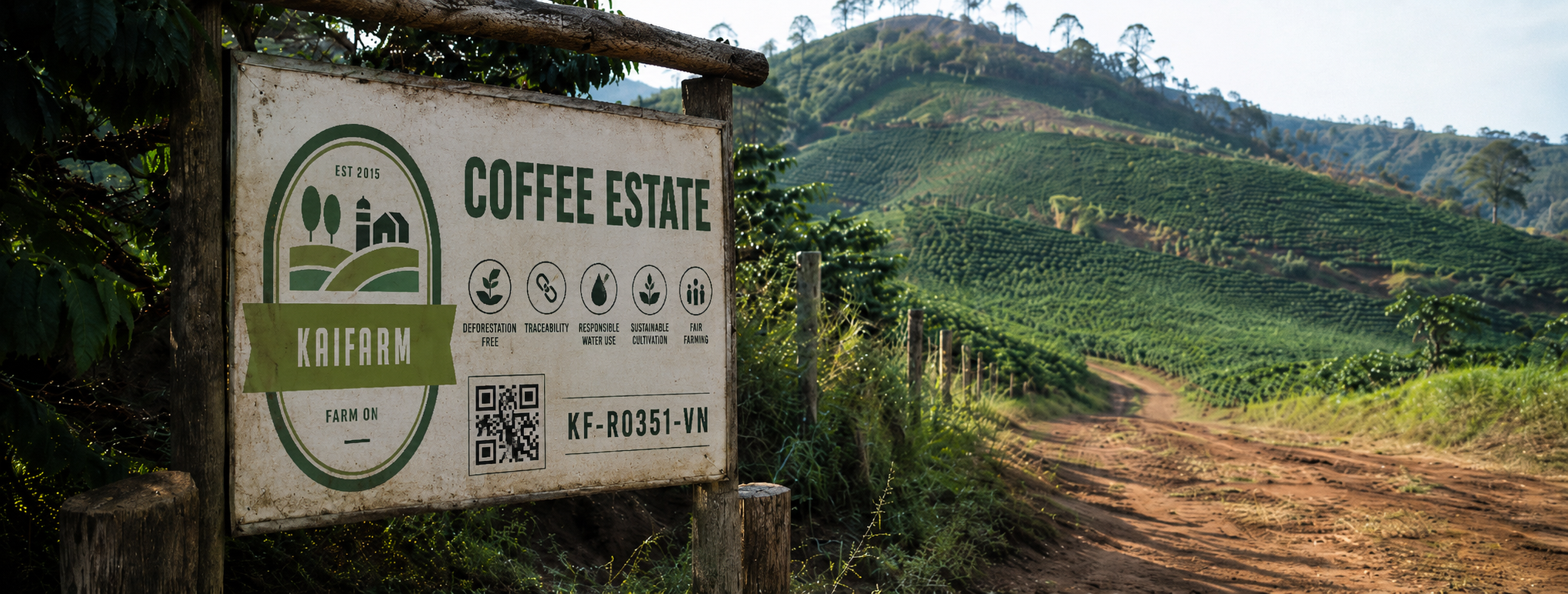
ABOUT FARM
On Feb 15, 2026: We have revised the content of this article to reflect some of our new business activities.
KAI Farm – Company Profile
Founded in 2015, KAI Farm is a wholly-owned subsidiary of KAI Holding, a London-based investment conglomerate with diversified interests across multiple sectors. From its inception, KAI Farm was established with a clear mandate: to build a vertically integrated agribusiness capable of operating at the highest standards of quality, ethics, and commercial efficiency across the global supply chain.
What began as a focused operation in premium coffee procurement and specialist roasting has since evolved into a multi-commodity agribusiness platform with operations spanning Southeast Asia, West Africa, and South America. Today, KAI Farm manages a portfolio that includes owned plantations, advanced processing facilities, international procurement networks, and dedicated research divisions — each component designed to reinforce and complement the others.
Across every market we operate in, our approach is consistent: combine deep local knowledge with global commercial expertise, uphold the highest standards of environmental and ethical practice, and invest in the technology and talent needed to remain at the forefront of a rapidly evolving industry.
Manufacturing & Processing
At the heart of KAI Farm’s operations is a robust and technically advanced manufacturing infrastructure. We operate three modern manufacturing facilities, collectively housing more than 20 dedicated coffee roasting production lines. Each line is equipped with industrial-grade roasting technology calibrated to handle diverse bean profiles — from light, aromatic specialty roasts to the deep, full-bodied profiles favoured in commercial blending.
Quality control is embedded at every stage of the production process. Raw material intake, moisture analysis, colour sorting, roasting curve management, and post-roast packaging are all governed by strict internal protocols and subject to regular third-party audits. The result is a product that consistently meets — and frequently exceeds — the expectations of buyers in our most demanding markets.
Beyond coffee, our facilities have been progressively adapted to support the preprocessing, packaging, and value-added processing of a growing range of agricultural commodities. This flexibility is a deliberate strategic asset: it allows KAI Farm to respond to shifting market demands, onboard new commodities efficiently, and maximise the return on our infrastructure investment. Current non-coffee processing capabilities include cashew handling, cocoa preprocessing, and dry agricultural goods packaging — with further expansion planned in line with our broader commodity diversification strategy.
Global Sourcing & Distribution
KAI Farm’s sourcing model is built on direct, long-term relationships with producers across some of the world’s most productive agricultural regions. Our primary sourcing hubs are located in Southeast Asia — where we have deep roots in Vietnam’s Central Highlands — and across West Africa, where our presence continues to grow. These regions collectively produce some of the highest-quality coffee, cashew, cocoa, and other commodities traded globally, and our on-the-ground presence gives us a meaningful sourcing advantage over purely desk-based competitors.
On the distribution side, our export network reaches buyers across the United States, Australia, Europe, and China. Each of these markets has distinct quality requirements, regulatory frameworks, and commercial expectations, and our team is structured to navigate these nuances with precision. We work with a combination of long-term contractual partners and spot market buyers, maintaining the flexibility to optimise our commercial position across both channels.
Underpinning our global reach is a supply chain infrastructure that has been built and stress-tested over nearly a decade of international operations. Our logistics capabilities encompass export documentation, phytosanitary compliance, container management, freight coordination, and customs clearance across multiple jurisdictions. This operational depth allows us to make and honour commitments that many smaller competitors cannot — a distinction that matters greatly to the importers and institutional buyers who rely on us.
Ethical Sourcing
The agribusiness sector operates in complex social and environmental contexts. At KAI Farm, we recognise that the decisions made at the procurement level — who we buy from, on what terms, and under what conditions — have real consequences for the farmers, communities, and ecosystems at the base of the supply chain. Our ethical sourcing framework is our formal response to that responsibility.
In practice, this means we establish transparent, pre-agreed pricing structures with our farmer partners — structures that reflect the true cost of production and provide growers with a reliable income they can plan around. We do not engage in exploitative spot purchasing practices, and we actively avoid supply chains where labour abuses or land rights violations have been identified. Our procurement teams are trained not only in commercial negotiation but in the social dynamics of the farming communities they work within.
Beyond individual transactions, we invest in the long-term development of our supplier base. This includes providing access to agricultural inputs, sharing technical knowledge on yield improvement, and in some cases co-investing in infrastructure that benefits the broader farming community. These efforts are not merely philanthropic — they produce better, more consistent raw material, reduce supply chain risk, and build the kind of loyalty that sustains commercial relationships across market cycles.
Our ethical sourcing commitments are documented, monitored, and reported on internally. We are in the process of formalising third-party verification across our key supply chains, and we welcome scrutiny from partners, investors, and civil society organisations who wish to understand our practices in greater detail.
Plantations & Land Assets
KAI Farm’s owned agricultural assets form the foundation of our supply chain security and long-term value creation strategy. In Vietnam’s Central Highlands — a region internationally recognised for its exceptional growing conditions — we own and operate over 900 hectares of high-yield Robusta coffee plantations. These plantations are managed using a combination of traditional agronomic expertise and modern farm management practices, producing consistent volumes of high-quality green coffee that feed directly into our processing and export operations.
In the cocoa sector, we hold a 51% controlling stake in Minh Thien Group, which manages 600 hectares of cocoa tree plantations, also located in the Central Highlands. This investment positions KAI Farm as a significant participant in Vietnam’s emerging cocoa industry — a sector that is attracting growing international interest as global buyers diversify their sourcing away from traditional West African origins.
All of our plantation assets are managed in strict accordance with environmental best practice. Soil health programmes, water management systems, integrated pest management, and biodiversity conservation measures are all embedded in our standard farm management protocols. We view our land not simply as a productive asset, but as an ecological responsibility — and we manage it accordingly. This approach also ensures that our plantations remain productive, resilient, and commercially valuable over the long term, protecting the interests of both our business and the communities that depend on the surrounding landscape.
Cashew Processing – Vietnam
Cashew is one of the most commercially significant tree nuts traded globally, and Vietnam is among the world’s largest processors of raw cashew kernels. KAI Farm is investing substantially in this sector through the construction of a dedicated cashew processing plant in Dong Phu District, Binh Phuoc Province — a region that sits at the heart of Vietnam’s cashew processing industry.
The facility has been designed to operate at industrial scale from day one. The main factory building spans 15,000 m², housing processing lines for shelling, peeling, grading, and packaging. Supporting the factory are 5 hectares of purpose-built drying yards and storage areas, designed to handle the high volumes of raw cashew that flow through the region during peak procurement seasons. The facility’s layout and equipment selection have been optimised for both processing efficiency and product quality, enabling us to produce finished cashew kernels that meet the specifications of buyers in our key export markets.
Construction is progressing on schedule, with operations expected to commence by end of 2025. Once fully operational, this facility will significantly expand KAI Farm’s downstream processing capacity, reduce our dependence on third-party toll processing, and improve our margin capture across the cashew value chain. It also positions us to take greater advantage of our raw cashew procurement capabilities in West Africa, creating a fully integrated farm-to-market pathway for this commodity.
Cashew Operations – Ghana
In 2024, KAI Farm established a fully operational cashew procurement and processing station in Accra, Ghana — a strategic move that marks a significant expansion of our African operations and our cashew supply chain capabilities. Ghana is a major cashew-producing country, and its geographic position makes it an ideal hub for sourcing raw cashew not only from domestic production but from neighbouring producing countries across the West African region.
The Accra facility has been built to handle substantial volumes of raw cashew material. The infrastructure includes 8 hectares of warehousing and light processing facilities equipped for the reception, sorting, grading, and initial treatment of raw cashew nuts, alongside 22 hectares of open drying yards designed to manage the large-volume throughput required during peak harvest periods. A professional, locally-embedded procurement team manages all aspects of day-to-day operations — from farmer and trader relationships to logistics coordination and quality assurance.
The establishment of this facility has enabled KAI Farm to move beyond simple procurement and into active wholesale trading of African raw cashews. We are now executing both afloat sales — where cargo is traded while in transit on the ocean — and destination sales to buyers in processing markets including Vietnam, India, and Europe. This trading capability adds a meaningful new revenue stream to our cashew operations and deepens our integration into global cashew commodity markets.
Looking ahead, the Accra station is designed to scale. As our procurement networks across West Africa mature and our trading volumes grow, we have the physical infrastructure and operational platform to expand throughput significantly without requiring major additional capital investment.
Arabica Coffee – Brazil
KAI Farm’s history is rooted in coffee, and our ambitions in this sector continue to expand. Our next major frontier is Arabica coffee cultivation in Brazil — the world’s largest coffee producer and the unrivalled home of high-quality Arabica production. Specifically, we are focusing our attention on the state of Minas Gerais, which produces the majority of Brazil’s Arabica output and is home to some of the country’s most respected and productive plantation operations.
We have been building relationships with major plantation owners in the region over an extended period, gaining a detailed understanding of the local land market, agronomic conditions, regulatory environment, and commercial dynamics. Pre-project planning has been completed in full, encompassing agronomic assessments, financial modelling, operational design, and risk analysis. Capital preparation for this project is now underway, with land acquisition targeted to begin in 2026.
This initiative reflects a deliberate strategic decision to diversify our coffee portfolio beyond Robusta — which remains our core — into the premium Arabica segment. Arabica commands significantly higher prices in international markets and is in growing demand from specialty roasters, retail brands, and food service operators globally. Establishing a production base in Brazil will give KAI Farm direct access to the world’s finest Arabica growing conditions, and position us to serve a segment of the coffee market that we currently address only through third-party procurement.
Durian Plantation – Vietnam
Durian is one of Southeast Asia’s most commercially valuable fruit crops, commanding premium prices in export markets — particularly China, where demand for high-quality Vietnamese durian has grown dramatically in recent years. Recognising this opportunity, KAI Farm has commenced land rehabilitation work for a 20-hectare trial plantation of high-yield durian varieties in Dong Phu, Binh Phuoc Province.
This project is being approached with the same rigour we apply to all our agricultural investments. The trial plantation phase will allow us to evaluate variety performance, establish optimal agronomic protocols, and build the operational expertise needed to manage durian at commercial scale. Binh Phuoc’s soil profile and climate are well-suited to durian cultivation, and the province is already home to a number of successful large-scale durian operations whose experience we are drawing on in our planning.
If the trial phase delivers the results we expect, this project has the potential to scale substantially. Durian represents exactly the kind of high-value, export-oriented crop that fits KAI Farm’s commercial strategy — a crop where quality-focused, well-managed producers can achieve strong returns and build lasting relationships with premium buyers. We are approaching this initiative with patience and discipline, prioritising agronomic quality over speed of expansion.
Research & Intelligence
KAI Farm’s competitive edge is not built on scale alone. It is built on knowledge — knowledge of markets, of agronomic science, of technology, and of the complex systems that connect producers to consumers across global supply chains. To formalise and accelerate the development of this knowledge base, we have established two dedicated research functions that serve both our internal operations and the broader agribusiness community.
Data Research & Market Analysis Team
Commodity markets are complex, volatile, and frequently opaque. Prices shift on the basis of weather events, policy changes, shipping disruptions, currency movements, and speculative flows — often faster than market participants can respond. KAI Farm’s Data Research and Market Analysis team exists to cut through this complexity and provide structured, actionable intelligence to the people who need it most.
Internally, the team supports our procurement, trading, and investment functions with timely analysis of price trends, supply and demand dynamics, origin-level conditions, and macroeconomic factors relevant to our commodity portfolio. This research informs our hedging strategies, procurement timing, contract structuring, and medium-term capital allocation — contributing directly to commercial performance.
Externally, the team produces two categories of published research. The first is a series of public-facing reports, made freely available to farmers, traders, industry associations, and other market participants as a contribution to transparency and knowledge-sharing across the agricultural community. The second is a suite of private research products — deeper, more detailed analyses prepared for partners, investors, and institutional clients who require premium-grade intelligence for their own strategic and commercial decision-making. These private reports cover topics including origin supply assessments, trade flow analysis, logistics cost benchmarking, regulatory developments, and long-range commodity outlook.
The underlying philosophy is straightforward: better information produces better decisions, and better decisions produce better outcomes — for KAI Farm, for our partners, and for the farming communities at the base of the supply chains we operate within.
AI Research, Development & Agricultural Applications Team
Agriculture is one of the world’s oldest industries, but it is also one of the most data-rich — and one of the least digitised. Satellite imagery, sensor networks, weather data, historical yield records, soil analyses, and logistics datasets collectively contain enormous predictive power that remains largely untapped by most agricultural businesses. KAI Farm’s AI Research and Agricultural Applications team was established specifically to change that, both within our own operations and as a contribution to the broader modernisation of the agribusiness sector.
The team’s work spans the full lifecycle of agricultural production and trade. In the field, we are developing and deploying machine learning models for crop yield forecasting — models that integrate satellite-derived vegetation indices, weather patterns, and historical production data to generate accurate, early-stage harvest predictions. These predictions improve our procurement planning, reduce the risk of over- or under-commitment, and give our farmer partners better visibility into the value of their upcoming harvests.
At the plantation level, we use remote sensing and multispectral satellite imagery to monitor the health, growth, and stress indicators of our owned and partner plantations in near-real-time. This capability allows our agronomy teams to identify and respond to issues — whether pest pressure, water stress, or nutrient deficiency — far earlier than traditional ground-based monitoring permits, reducing losses and improving overall plantation productivity.
Within our processing facilities, we are implementing AI-assisted quality grading systems that use computer vision to assess the physical attributes of incoming raw material and finished product. These systems reduce human error, increase throughput consistency, and generate the kind of objective, data-backed quality documentation that premium buyers increasingly require. On the logistics side, predictive tools are being developed to optimise container utilisation, routing decisions, and procurement timing — reducing costs and improving the reliability of our delivery commitments.
The team operates in close partnership with our farm management, procurement, processing, and trading divisions, ensuring that research outputs move rapidly from proof-of-concept into operational deployment. We also maintain active relationships with academic institutions, technology startups, and industry research bodies — keeping us connected to the leading edge of agricultural AI development globally. Our ambition is not simply to adopt the tools that others build, but to develop proprietary capabilities that give KAI Farm a durable and defensible competitive advantage.
Get in Touch
KAI Farm is more than an agribusiness. It is a working model of what sustainable, ethical, and commercially excellent operations can look like in the modern agricultural sector — one that takes seriously its responsibilities to the farmers it works with, the environments it operates within, and the customers and partners it serves.
We are always open to conversations with potential partners, buyers, investors, researchers, and anyone else who shares our interest in building a better, more transparent, and more sustainable global agricultural system. Please reach out to us through the contact details below — we look forward to hearing from you.
Headquarters
▬ Address: 9th Floor, Diamond Plaza Building, 34 Lê Duẩn Street, Bến Nghé Ward, District 1, Ho Chi Minh City, Vietnam.
▬ Email: info@kaifarm.uk – Phone: 028 7109 1212 – Ext. 500
Operations Team
▬ Address: KAIHub, Floor 18 – Deutsches Haus, 33 Le Duan Street, District 1, Ho Chi Minh City, Vietnam.
▬ Email: ops@kaifarm.uk – Phone: 028 7109 1212 – Ext. 522
Sales and Partner Relations
▬ Address: KAIHub, 1203 – MPlaze Saigon Tower, 39 Le Duan Street, Ben Nghe Ward, District 1, Ho Chi Minh City, Vietnam.
▬ Email: cs@kaifarm.uk – Phone: 028 7109 1212 – Ext. 511
Singapore Representative Office
▬ Address: KAIHub, 09-16th Floor, Marina Bay Financial Centre Tower 2, 10 Marina Boulevard, Singapore 018983
▬ Email: sg@kaifarm.uk – Phone: +65 6223 1818 (0930 – 1530hrs, Monday – Friday)