What the Harvest Doesn’t Count: The Women and Children Behind Every Bag of Vietnamese Coffee
The survey team that visited Ea H’leo District in Dak Lak Province two years ago recorded the household as a two-person farming operation. The land title is in the husband’s name. The bank loan taken out in 2019 to finance a partial replanting is in the husband’s name. When the trader comes with his scale and his clipboard in November, he asks for the husband by name. In the official record of Vietnamese coffee production, Pham Thi Mai does not exist.
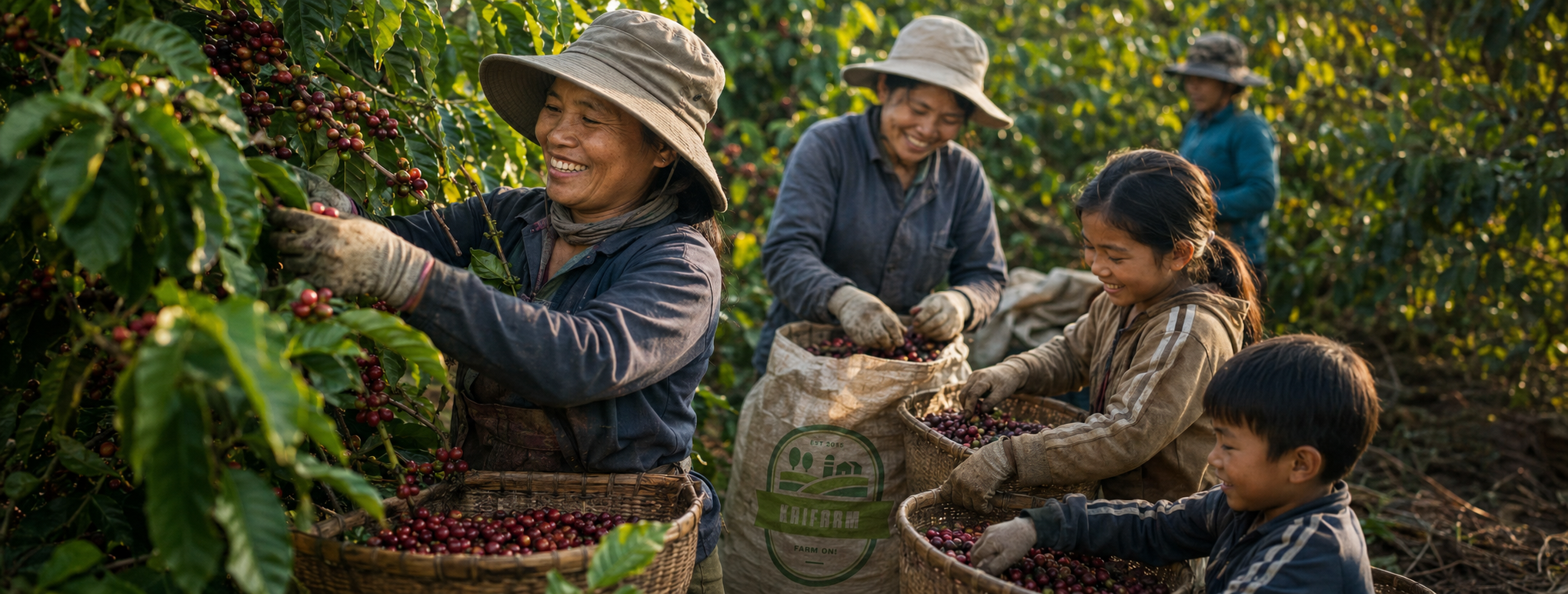
She is thirty-nine years old. She wakes at five in the morning every day of the year, and at four-thirty during the two months of harvest. She has been doing this since she married into the farm at twenty-two, and she will likely be doing it when she is fifty, and possibly when she is sixty, in the way that the labor of women in smallholder agriculture does not retire on any fixed schedule but simply continues until the body makes it impossible. On any given morning during the October-to-December harvest season, Mai will have cooked breakfast for the family and the hired workers, packed lunches into cloth bags, walked the twenty minutes to the far section of the garden, picked coffee cherries for six to seven hours, carried the full harvest bag — thirty to forty kilograms — to the collection point at the edge of the plot, returned to the house to begin the evening meal, sorted through the day’s pick to remove under-ripe and over-ripe cherries before wet processing, and put her youngest child to bed. None of this appears on a balance sheet. None of it is counted in the farm’s labor costs. The household’s apparent profit margin exists, in part, because her working day is classified as something other than work.
Her husband, Hung, is not an absent figure. He works alongside her in the garden, manages the irrigation system, handles the fertilizer schedule, and negotiates with traders. He is the visible operator of the farm in every external interaction, and he is also, genuinely, a capable farmer whose technical decisions have shaped the garden’s productivity over fifteen years. The point is not that he does nothing. The point is that what she does is structured out of the accounting from the beginning — not through deliberate concealment but through a set of assumptions about household labor that run so deep in agricultural practice that they are rarely examined even by the people inside them.
The farm is 2.5 hectares of robusta coffee in its twelfth year, planted on a gentle slope about four kilometers from the main road. In a good year it produces between 10 and 12 tons of fresh cherry. Last season came in at 9.4 tons, slightly below the household’s baseline expectation due to an irregular flowering period in January caused by an unseasonal rain event. At a farm-gate price of around 12,000 dong per kilogram of fresh cherry, the gross revenue was approximately 112.8 million dong. Hung calculates the farm’s annual costs at around 65 million dong: fertilizer and soil amendments at 38 million, pesticides and fungicides at 9 million, hired labor for harvest at 16 million, and miscellaneous costs — irrigation electricity, equipment maintenance, transport to the collection point — at roughly 2 million. By this accounting, the farm generated a net return of approximately 47.8 million dong last year.
But the 16 million dong in hired labor costs covers only the additional workers brought in during the peak harvest weeks — typically four to five people for twenty to twenty-five days at 320,000 dong per day. It does not cover Mai. It does not cover Hung’s labor, which if priced at the same daily rate across the full agricultural calendar would add another 35 to 40 million dong to the cost column. And it does not cover the labor of their two children — a daughter of fourteen named Tuyen and a son of eleven named Bao — whose contributions to the farm’s operation are small on any individual day and substantial across a full year.
Tuyen has been helping with the harvest since she was nine. She is now capable of picking a full row without supervision, sorting cherry by ripeness with an accuracy that some adult pickers cannot match, and managing the wet processing basin — filling, timing the fermentation, and draining — without being asked. During the school year she works in the garden on weekends and on weekday afternoons when the homework is finished, or sometimes when it is not. She does not complain about this, or at least she does not complain in ways that register as complaint in a household where the boundary between family life and farm work has never been clearly drawn. When asked what she wants to do after secondary school, she says she wants to study accounting in the city. She says it the way children say things they have been told are possible without being entirely certain that they are.
Bao is too young for the heavy work but not too young for the tasks that small hands and quick legs are suited to: collecting fallen cherries from the ground under the trees — a category of fruit that the adult pickers often miss and that, accumulated across the season, can add several hundred kilograms to the total yield — fetching water, running messages between sections of the garden, and the endless task of keeping the sorting area clear during processing. He goes to school every weekday. On Saturdays he is in the garden. On Sundays he is sometimes in the garden and sometimes not, depending on what needs doing. He is eleven years old and has already developed the particular competence of a child who has grown up understanding that the household’s stability is a collective project that he participates in, which is both a form of early education and a form of early burden that no one has calculated the cost of.
If you were to price every hour of labor that Mai, Tuyen, and Bao contribute to the farm at the going hired-labor rate — a thought experiment that agricultural economists sometimes run and that farm households almost never do — the picture changes substantially. Mai works at farm-level tasks for an estimated eight to ten hours per day during the two harvest months and four to five hours per day during the rest of the year, across a range of activities from direct field labor to processing, sorting, cooking for workers, and logistics management. Tuyen contributes perhaps two hours per weekday during the school year and six to seven hours on harvest-season weekends. Bao contributes an hour or two on most non-school days. Priced at 320,000 dong per eight-hour day, the combined unpaid labor of these three family members across a full year represents somewhere between 60 and 80 million dong in labor value that the farm consumes without recording. Added to the cost column, the farm’s 47.8 million dong net return becomes a net loss. The farm is viable, in the accounting that matters to a bank or a development survey, only because the labor that sustains it is invisible.
This is not unique to this household. It is the structural condition of smallholder coffee farming across the Central Highlands, and it is the reason that farm income figures derived from household surveys — which typically capture cash transactions and hired labor but not family labor contributions — systematically overstate the returns to coffee cultivation and understate the true cost of maintaining the households that produce it. The invisibility is not accidental. It is built into the measurement framework from the start, and the measurement framework shapes the policy responses, the extension services, and the development interventions that flow from it, most of which are designed for the farm as a unit of production rather than the household as a unit of survival.
Mai is aware of the economics in the way that people who live inside a system and have no alternative to it are aware of its terms — not analytically, not as injustice in any theoretical sense, but as the texture of daily life that she navigates without naming. When she says the farm is doing “okay” she means that the household is not in a position that requires emergency borrowing this year, which is a different statement from saying the farm is profitable, but the distinction does not have a word she uses. She knows that her labor is not counted. She knows this the way she knows the distance between the house and the far section of the garden — not as a figure but as a fact she inhabits.
What she has been thinking about more in the past year, in the way that worries surface gradually and then insistently, is Tuyen. The girl is finishing her third year of secondary school. She is, by the assessment of her homeroom teacher — relayed to Mai at a parent meeting in September — a student of genuine ability in mathematics and organizational reasoning, the kind of student who should consider the upper secondary track and, after that, a vocational or university program. The teacher said this with the particular directness of a rural educator who has watched capable students disappear into family labor before and knows that the window for intervention is specific and short.
The upper secondary school is in the district town, fourteen kilometers away. The options are a daily commute on a road that is unpaved for the last four kilometers and impassable during heavy rain, or accommodation in a rented room near the school at a cost of around 1.5 to 2 million dong per month plus meals. Added to school fees, books, and incidentals, sending Tuyen to upper secondary school would cost the household somewhere between 25 and 35 million dong per year — a sum that represents more than half of the farm’s net return in a median year, in a household that also has a younger child approaching secondary school age and two adults who have not set aside any formal retirement provision.
The evening Mai raises this with Hung, they are sitting at the table after the children are in bed, the account book open between them. It is November, the harvest is three weeks from finished, and the calculation has a concreteness it would not have had in July. Hung looks at the numbers for a long time. He does not say no. He says he does not know where the money comes from without taking a loan, and the household already carries 45 million dong in outstanding debt from the 2019 replanting, serviced at a rate that leaves little room for an additional obligation. Mai says she knows. She has been thinking about whether she could take on additional income during the off-season — perhaps processing work at the cooperative depot in the district town, which sometimes hires women for sorting and grading during the post-harvest months at around 200,000 to 250,000 dong per day. Hung says the distance is a problem. Mai says she can manage the distance.
What neither of them says, because it lives beneath the conversation rather than inside it, is that the question of Tuyen’s schooling is also a question about what the farm costs and who pays it. Sending Tuyen away means losing the labor she provides, which means either hiring a replacement — adding perhaps 8 to 10 million dong in annual labor costs — or absorbing her absence by working harder, which means Mai’s already uncounted hours becoming longer. The decision about a fourteen-year-old girl’s education is, at its economic foundation, a decision about whether the household can afford to stop consuming her labor, which is a question that should not have to be asked about a fourteen-year-old girl and that nevertheless must be answered.
They do not resolve it that night. The account book stays open on the table after they go to bed, the columns Hung has written in pencil still visible under the lamp Mai forgot to turn off. In the garden, the last of the season’s cherries are still on the trees, dark and ripe in the November air. Tomorrow morning at four-thirty, Mai will wake before the alarm. She will start the fire for breakfast. She will pack the lunches. She will walk to the garden. She will pick.
Tuyen will be beside her, working the next row, her hands moving through the branches with an efficiency that took five years to develop and that no labor survey has ever recorded. At some point during the morning, in the way that thoughts arrive during repetitive physical work, she will think about the accounting program she looked up on her phone the night before — a two-year diploma, a school in Buon Ma Thuot, a monthly stipend available to students from agricultural households that might cover part of the cost. She will think about it and then she will move to the next tree, because the harvest window does not accommodate thinking for long, and there is still a great deal left to pick.
KAIFarm® Team
People
People
Story
Story
Story
Story