No One to Inherit the Farm: Youth and the Future of Vietnamese Coffee
Introduction
Across the coffee-growing highlands of Vietnam — from the red basalt soils of Dak Lak to the misty terraces of Son La — a quiet but consequential exodus is unfolding. The people leaving are not seasonal migrants or displaced laborers. They are the sons and daughters of smallholder coffee farmers: the generation that was expected to inherit the land, sustain the harvest, and carry forward a sector that accounts for roughly 15% of Vietnam’s total agricultural export value.
Vietnam is the world’s second-largest coffee producer, generating approximately 1.5–1.8 million metric tonnes of Robusta annually, with a growing Arabica segment in the northern highlands. Behind this output are an estimated 600,000 to 700,000 smallholder farming households, the vast majority cultivating plots of 0.5 to 2 hectares. These households are the structural backbone of the supply chain — and they are aging, unstaffed, and increasingly uncertain about whether coffee farming has a future worth passing on.
This article focuses on one of the most consequential human trends shaping Vietnam’s coffee sector: the accelerating exit of younger generations from agricultural livelihoods. This is not simply a demographic footnote. It represents a compounding structural risk with direct implications for long-term productivity, supply chain resilience, and the social fabric of rural coffee communities.
Human Landscape of the Industry
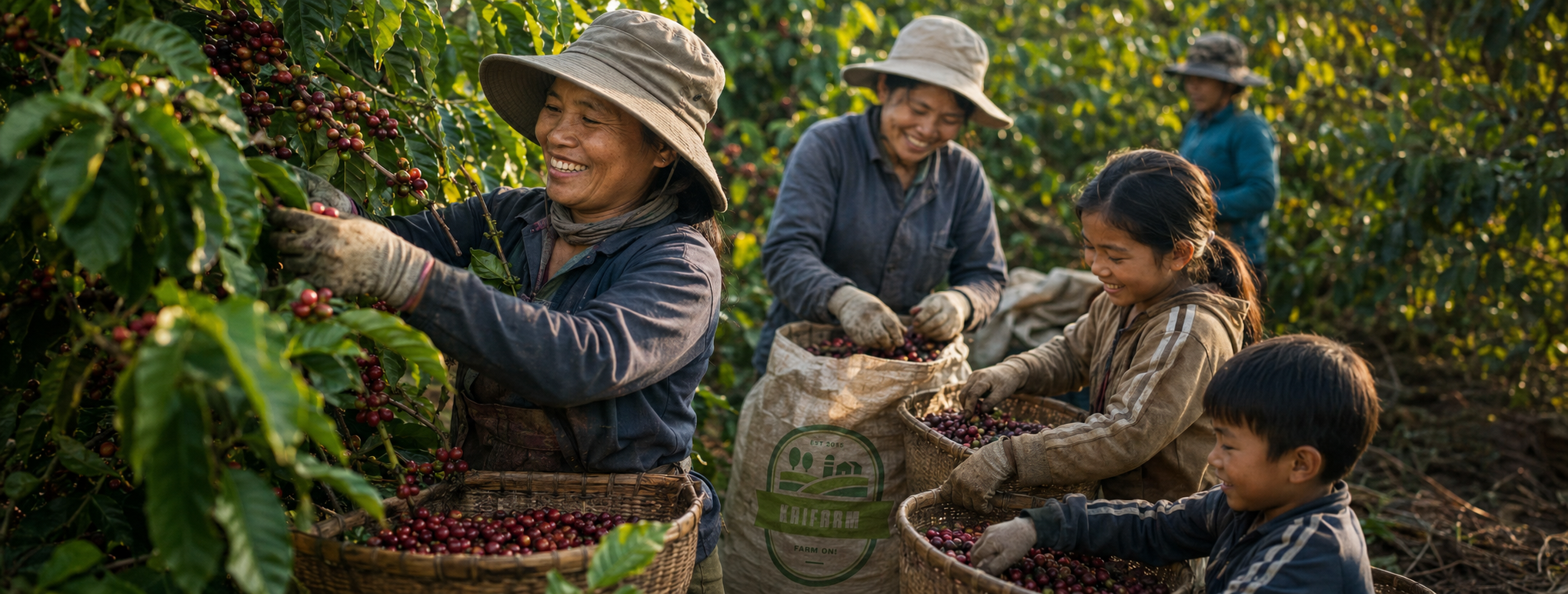
The typical Vietnamese coffee smallholder is a household head between 45 and 65 years of age, often an ethnic minority farmer in the Central Highlands (Kinh, Ede, Mnong, or Jarai), with limited formal education and deep, tacit knowledge of local growing conditions accumulated over decades. Their farm is family-operated, with labor supplemented by community exchange during peak harvest periods.
Income from coffee farming is highly variable. At a farm-gate price of 40,000–55,000 VND per kilogram of dried Robusta cherry (2023–2024 levels), a household with 1 hectare yielding 2.5–3 tonnes may generate gross revenues of 100–165 million VND per year (approximately USD 4,000–6,600). After deducting input costs — fertilizer, pesticide, irrigation, and hired labor — net household income typically falls in the range of USD 2,000–4,000 annually. This places most smallholder coffee families at or just above Vietnam’s rural poverty threshold, with minimal financial buffer.
Against this backdrop, the younger generation — broadly defined as adults aged 18–35 — faces a stark comparison: urban manufacturing wages in industrial zones such as Binh Duong or Dong Nai now range from USD 250–400 per month, offering not only higher and more stable incomes but also social insurance, structured working hours, and proximity to education, healthcare, and social mobility.
Key Socio-Economic Trends
Several converging trends are accelerating the generational departure from coffee farming:
- Rising urban wage premiums: The income gap between rural agricultural work and urban factory employment has widened significantly since 2015. For a 25-year-old with basic education, factory work in an export processing zone offers 3–4 times the effective daily income of farm labor, with none of the climate or price risk.
- Educational aspirations: Secondary and tertiary enrollment rates in rural Vietnam have risen sharply. Among children of coffee farmers, parents increasingly prioritize education as an exit pathway — not a complement to farming, but a replacement for it. This is both a rational household strategy and a cultural signal: farming is perceived as low-status work.
- Aging farmer profiles: Survey data from the Central Highlands suggests that the average age of active coffee farm operators has increased from approximately 42 years in 2010 to over 52 years by 2023. This aging-in-place dynamic creates a latent succession crisis: when the current generation retires or becomes physically unable to farm, there is no identified successor in the majority of households.
- Climate stress compounding decisions: Increasingly erratic rainfall patterns, prolonged dry seasons, and heat stress events in Dak Lak and Gia Lai provinces have made farming more physically demanding and economically unpredictable. For young people already weighing their options, climate shocks serve as a decisive final push toward urban migration.
Deep Dive: Why Younger Generations Are Exiting Coffee Farming
The youth exodus from Vietnamese coffee farming is not a single event but a layered decision shaped by economic rationality, social aspiration, structural exclusion, and a fundamental breakdown in the perceived viability of the agricultural livelihood model.
Behavioral and Economic Drivers
At its core, the decision to leave farming is a rational response to a flawed value proposition. When a young person calculates the return on farming — factoring in physical labor intensity (60–90 days of peak-season work, often in extreme heat), income unpredictability, and the multi-year investment horizon of perennial crops — against the immediate, predictable monthly wages of urban employment, the arithmetic consistently favors departure.
But behavioral economics adds a crucial layer. Young farmers are not simply income-maximizers; they are also identity-formers. Social comparison plays a significant role: when peers who migrated to cities return during Tet with smartphones, motorbikes, and urban clothing, the perceived status differential between “farmer” and “factory worker” becomes viscerally real. Farming carries an implicit social stigma among younger rural cohorts — it signals immobility, limited education, and foreclosed futures.
There is also a compounding effect of parental messaging. Many aging coffee farmers — having struggled through price collapses (the 2000–2002 global coffee glut reduced Vietnamese farm-gate prices by over 60%), input cost inflation, and climate shocks — actively discourage their children from continuing in agriculture. The very people best positioned to transfer farming knowledge are simultaneously signaling that this knowledge has diminishing value.
Household-Level Impact
When a household’s younger members migrate, the immediate effect is a labor deficit during the most critical and labor-intensive periods: flowering management (February–April) and cherry harvest (October–December). Coffee harvesting in Vietnam remains predominantly manual, requiring 30–50 person-days per hectare. Families that previously relied on intergenerational household labor now face the choice of hiring seasonal workers at 300,000–400,000 VND per day (USD 12–16), reducing harvested area, or accepting lower-quality, selective-picking standards.
Hired labor costs, when borne by a single aging farmer, can consume 25–40% of gross revenue — dramatically compressing net margins. This cost pressure creates a reinforcing cycle: declining profitability reduces reinvestment in the farm (pruning, fertilization, replanting), which reduces yields and quality, which further reduces income and accelerates the perceived futility of continuing.
Remittances from migrated children provide partial income support to aging parents, but they do not translate into farm reinvestment. Typically, remittances cover household consumption and medical expenses — not agronomic inputs. The farm effectively enters a slow disinvestment trajectory.
System-Level Consequences
At the industry level, the cumulative effect of generational exit creates several structural risks that are not yet fully visible in aggregate production data, but will materialize within the next 5–10 years:
- Productivity decline: As aging farmers reduce management intensity — fewer pruning cycles, reduced fertilizer application, delayed replanting of aging trees — yield per hectare will gradually decline. Vietnam’s average Robusta yield of 2.5–3 tonnes/hectare is already below its agronomic potential; under reduced management, yields could contract by 15–25% over a decade.
- Consolidation pressure: As individual smallholders become unable to manage their land, plot abandonment or distress sales to larger operators or land aggregators will increase. This risks displacing ethnic minority communities from ancestral lands — a process with significant social and political dimensions in the Central Highlands.
- Quality degradation: Younger, skilled labor is more receptive to quality-differentiated practices (selective picking, proper fermentation, certification protocols). An aging, shrinking workforce is more likely to resort to strip-picking and bulk processing — inconsistent with the specialty and certified coffee premiums that exporters and international buyers increasingly demand.
- Supply chain fragility: The concentration of productive capacity among a shrinking cohort of aging farmers increases vulnerability to localized shocks — a single bad harvest season or disease outbreak could have disproportionate supply impacts.
Structural Challenges
The generational exit is not simply a preference problem — it is embedded in structural conditions that make farming genuinely unattractive as a livelihood system for young people:
- Land tenure insecurity: Many smallholders, particularly ethnic minority farmers, hold land use rights (LUR certificates) that are informal or disputed. This limits their ability to use land as collateral for credit — preventing investment in productivity-enhancing technology that might make farming more attractive to successors.
- Weak cooperative infrastructure: Vietnam’s agricultural cooperative system remains underdeveloped in the coffee sector. Fewer than 20% of smallholder coffee farmers are members of functional cooperatives that provide input procurement, technical training, or market access support. Young farmers operating alone face prohibitive transaction costs and bargaining disadvantages.
- Absence of agricultural social protection: Unlike formal sector employment, farming provides no pension, health insurance, or unemployment protection. The risk of a bad year falls entirely on the household — a prospect that is especially unappealing to younger generations who have observed their parents absorb these shocks without institutional support.
- Knowledge and extension gaps: Agricultural extension services in Vietnam’s Central Highlands are chronically understaffed. The ratio of extension officers to farming households often exceeds 1:500. Young farmers who might be interested in modernizing their operations — adopting precision irrigation, intercropping, or regenerative practices — have few reliable sources of technical guidance.
Strategic Recommendations
Reversing the generational exit from coffee farming requires interventions that address both the economic and identity dimensions of the problem. Generic training programs and certification schemes, in isolation, are insufficient. The following recommendations are grounded in the behavioral and structural realities described above:
- Redesign the farming value proposition for young people: Pilot “young farmer enterprise” models that reframe coffee farming as a managed agribusiness rather than subsistence labor. This means connecting young farmers directly to specialty buyers, providing access to cupping and quality assessment skills, and enabling premium price capture. A farmer earning USD 6,000–8,000 annually from 1 hectare of high-quality, certified Arabica has a fundamentally different livelihood calculus than one earning USD 2,500 from bulk Robusta.
- Invest in farm mechanization adapted to smallholder scale: Affordable mechanical harvesters and precision fertigation systems can reduce the physical labor burden that makes farming unappealing. Cooperative-based equipment sharing models can spread capital costs across members — but require functional cooperative governance to succeed.
- Create structured succession planning mechanisms: Work with local governments and cooperatives to develop farm succession frameworks — including land transfer protocols, intergenerational mentoring programs, and conditional financing for young farmers willing to take over and invest in existing plots.
- Build social protection floors for smallholders: Advocate for the extension of contributory social insurance (pension, health) to agricultural smallholders — reducing the perception of farming as a high-risk, safety-net-free livelihood. This is a policy-level intervention requiring engagement with the Ministry of Agriculture and Rural Development (MARD) and the Vietnam Social Security agency.
Conclusion
The youth exodus from Vietnam’s coffee farming communities is not a trend that will self-correct. It is the rational, cumulative outcome of decades of structural underinvestment in smallholder livelihoods, compounded by widening urban opportunity gaps and a cultural devaluation of agricultural work. If current trajectories continue, Vietnam’s coffee sector faces a slow-motion productivity crisis that will manifest fully within 10–15 years — not as a sudden collapse, but as a gradual erosion of the human capital that sustains the supply chain.
The stakes extend beyond economics. In the Central Highlands, coffee farming is not merely an income source — it is the social and cultural organizing principle of entire communities. As farming households dissolve through migration and aging, the communities they anchor will fragment. The children who leave do not typically return. The land, the knowledge, and the social ties accumulated over generations are not easily reconstituted.
Addressing this challenge requires moving beyond productivity metrics and certification frameworks to ask a more fundamental question: can coffee farming be made into a livelihood that a 25-year-old in 2026 would genuinely choose? The answer is not predetermined — but it requires deliberate, human-centered intervention before the window for meaningful change closes.
KAIFarm® Team
People
People
Story
Story
Story
Story