No Hands at Harvest: How the Labor That Built Vietnam’s Coffee Belt Is Quietly Walking Away
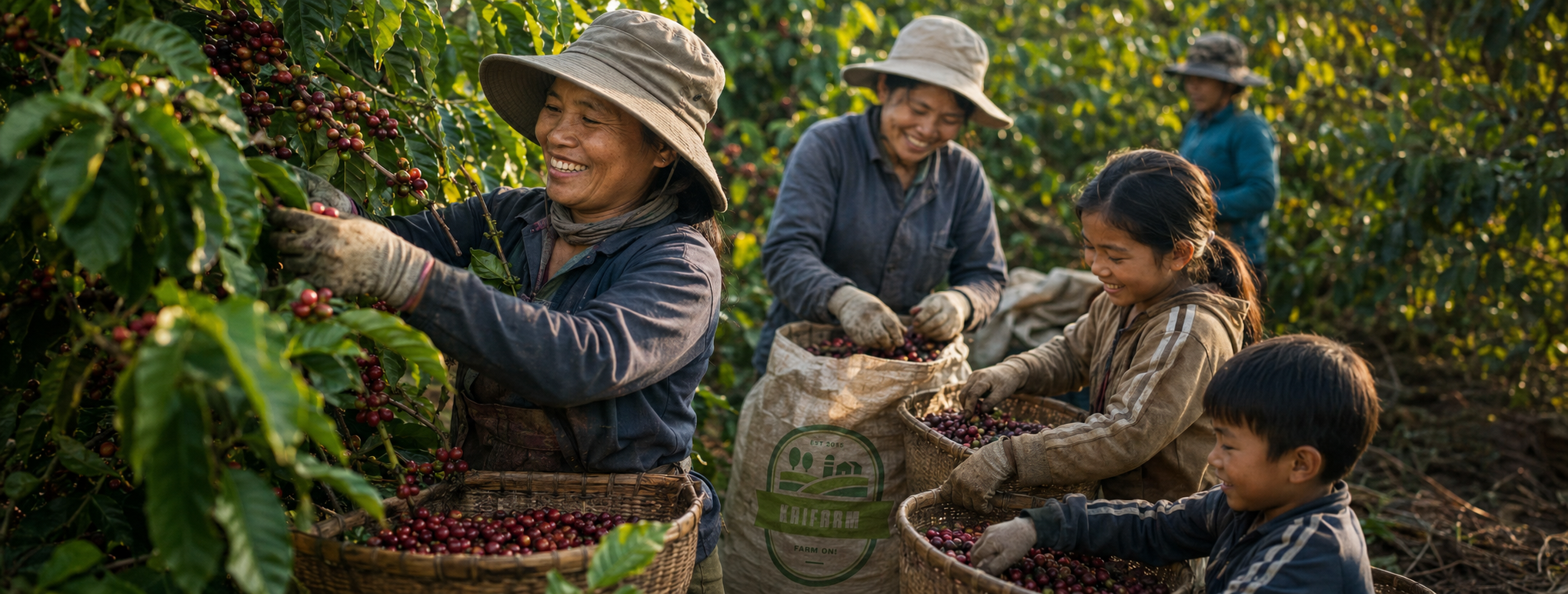
By the time Tran Van Duc realizes he does not have enough people, the cherries are already turning red. This happens every year now — not the ripening, which follows its own reliable schedule across the slopes of Dak Lak Province, but the realization, which arrives later each season and lands harder each time. He has three hectares of robusta coffee at peak production, a narrow harvest window of four to six weeks between late October and early December, and in the weeks leading up to this year’s picking season, he has confirmed exactly four hired workers willing to come. He needs at least ten.
Duc is forty-eight years old, a second-generation coffee farmer in a village outside Buon Ma Thuot where the crop has been the economic backbone for as long as anyone has needed to explain why they stayed. His parents planted their first trees in the mid-1980s, when the state-led expansion of coffee cultivation across the Central Highlands was drawing settlers and creating smallholder plots out of forest land. Duc inherited the farm in his twenties and expanded it gradually, replanting with improved varieties and adding a third hectare in 2008 when prices justified the investment. For most of his adult life, the hardest part of farming was the uncertainty of markets. The labor, he assumed, would always be there.
It is no longer always there. The agricultural labor pool in the Central Highlands has been draining for years through a process so gradual and so ordinary that it registered more as background noise than alarm — young men and women from farming families leaving for factory jobs in industrial zones in Binh Duong, Dong Nai, and Ho Chi Minh City; seasonal workers from ethnic minority communities who once supplemented their incomes through coffee harvesting choosing instead the more predictable wages of construction or processing plants; and a broader rural-to-urban migration that has accelerated since the mid-2010s and shows no structural sign of reversing. What remains is an older, smaller pool of available harvest labor competing with a fixed and unforgiving seasonal calendar shared by every coffee farmer in the region simultaneously.
The harvest window is the cruelty at the center of this problem. Coffee cherries do not wait. A robusta cherry left on the tree two weeks past its optimal ripeness will begin to over-ferment, affecting cup quality and, more immediately relevant to a farmer selling at farm-gate, reducing the dry weight of the bean inside. The entire region’s crop ripens within roughly the same six-week band, which means every farmer in Dak Lak Province is looking for labor at the same moment. In a well-functioning labor market with adequate supply, this simultaneity would simply drive wages up during the peak window and back down afterward. In the current market, the supply constraint is severe enough that wage increases have begun to coexist with actual scarcity — meaning that even at higher prices, the workers are sometimes simply not available.
Three years ago, Duc paid hired harvesters 200,000 dong per day plus meals. Two years ago the rate had moved to 250,000 dong. Last season he paid 320,000 dong per day, prepared lunch and dinner himself — or rather, his wife Lan prepared them, rising at five in the morning to cook for whoever showed up — and still finished the harvest short-handed, leaving an estimated 180 to 200 kilograms of ripe cherries unpicked on the outer branches of trees he simply ran out of labor to reach in time. At a farm-gate price of around 12,000 dong per kilogram of fresh cherry, those unpicked cherries represented roughly 2.2 to 2.4 million dong of foregone revenue — not a catastrophic loss in isolation, but a number that sits uncomfortably in a farm income calculation that already has thin margins.
The four workers who have committed to come this year are all men between the ages of fifty-five and sixty-four. Two of them have been harvesting on Duc’s farm for more than a decade. One, a man named Ksor Mlih from a Jarai community about twelve kilometers away, has been coming every October since 2009 and knows the layout of the garden well enough to work without direction. These are not casual laborers. They are skilled, reliable, and increasingly rare — a cohort whose younger counterparts made different choices and whose own capacity to do the physical work of harvest picking, which involves bending, reaching, and carrying loads of thirty to forty kilograms for eight hours a day, will not extend indefinitely.
Duc has tried to solve the problem through his social network first, which is the way most smallholder farmers in this region approach labor procurement. He has called relatives in adjacent villages, neighbors who sometimes exchange labor during harvest, and the adult children of families he has known for years. The calls have produced polite responses and, mostly, unavailability. One nephew works a shift job at a garment factory in Binh Duong and cannot take the leave. A neighbor’s son spent last harvest season picking coffee in Gia Lai Province for a larger farm that could offer guaranteed thirty-day contracts — the continuity of income more valuable to him than proximity to home. Two young men from the village who picked for Duc two years ago are now driving motorbike taxis in Buon Ma Thuot city, earning 200,000 to 300,000 dong on good days with the freedom to stop when they want and no mud on their boots.
The economics of harvest labor have shifted in ways that are difficult for smallholders to compete against directly. A daily wage of 320,000 dong for coffee picking is not a low wage by rural standards, but it is seasonal, physically demanding, weather-dependent, and geographically fixed. A factory job paying 7 to 8 million dong per month offers less per day in raw terms but provides twelve months of income, social insurance contributions, dormitory accommodation, and the psychological value of a life that is legible to a bank, a landlord, or a future spouse’s family in ways that seasonal farm labor is not. Young workers are not making irrational decisions when they leave. They are responding accurately to a set of incentives that has been restructured by Vietnam’s industrial expansion, and the coffee farms of the Central Highlands are on the losing side of that restructuring.
Duc’s wife, Lan, picks alongside the hired workers every day of the harvest season. She does not count herself in the labor cost calculation. Neither does Duc, who works the same hours. Together they contribute what amounts to two additional full-time positions across the harvest period — roughly sixty person-days of labor at replacement cost of 320,000 dong per day, or approximately 19.2 million dong of unpaid household labor that the farm’s apparent profitability depends on without acknowledging. This is not unusual. It is the norm across smallholder coffee farming in the region, and it means that the economics of the farm look viable partly because the household absorbs costs that would otherwise appear on a balance sheet.
The turning point in Duc’s season comes on a Tuesday in mid-November, two weeks into the harvest. Ksor Mlih arrives in the morning with news that his nephew, who had been tentatively available and whom Duc had been counting on as a fifth worker, has taken a last-minute offer to work at a larger farm in Cu M’gar district that is paying 350,000 dong per day and providing accommodation. The larger farm can offer this because it has the scale to amortize accommodation costs and the cash reserves to front higher wages. Duc cannot match it without borrowing, and borrowing to pay harvest wages against a crop not yet sold introduces a risk he is not prepared to take on top of the risks already baked into the season.
He sits with Lan that evening and works through the numbers on the back of a fertilizer receipt. They have harvested approximately 60 percent of the garden in two weeks with five workers including themselves. At the current pace, completing the remaining 40 percent will take another week and a half with four workers. But the cherries in the eastern section, which ripen slightly later due to afternoon shade, will be at peak ripeness in roughly ten days. If they cannot get to the western section — already at peak — in the next five days, they will begin losing quality and weight. He estimates the potential loss at between 300 and 500 kilograms of cherry across that section, depending on how quickly the over-ripening progresses. At current prices, that is between 3.6 and 6 million dong.
He considers hiring a mechanical harvester — a stripping device that can be rented from an agricultural services cooperative in the district for around 800,000 dong per day. He has used one before, on a neighbor’s farm, and knows its limitation: it strips indiscriminately, taking unripe and over-ripe cherries alongside the optimal ones, reducing the overall quality of the batch and compressing the farm-gate price he can expect from the trader. For a farmer selling undifferentiated robusta to a local collector, the price penalty for a mixed-quality batch may be 1,000 to 2,000 dong per kilogram — a reduction that, spread across the affected portion of the harvest, could cost as much or more than the labor shortage it was meant to solve. He rules it out for the eastern section, where the late-ripening cherries would suffer most from indiscriminate stripping. He decides to rent the machine for the western section, where most cherries are already at peak and the uniformity risk is lower, and concentrate his four human workers on the eastern rows where selective hand-picking still makes economic sense.
It is not an ideal solution. It is the least bad option available within the constraints of his capital, his labor supply, and his time. He writes the figures down, crosses out two alternatives, circles the hybrid approach, and goes to bed at nine-thirty because Ksor Mlih will arrive at five-forty-five and the dew needs to be off the leaves before picking starts.
The mechanical harvester comes on Thursday. It covers the western section in a day and a half. The operator, a young man who services a dozen farms during the harvest season and has learned the machine’s rhythms better than most, works quickly and without waste. The batch from the western section goes to the collector at a slight quality discount — 11,500 dong per kilogram instead of the 12,200 dong Duc was quoted for hand-picked cherry the previous week. The difference is manageable. The time saved allows the four human pickers to focus entirely on the eastern rows, where Ksor Mlih works with the unhurried efficiency of someone who has done this particular task on this particular land for fifteen years and has internalized its specific demands.
By the first week of December, the harvest is complete. The final tally is approximately 28.6 tons of fresh cherry across three hectares — a yield Duc describes as average, neither good nor bad, the kind of season that pays costs and services debt without producing anything that could be called a surplus. Total hired labor costs came to just under 14 million dong. The mechanical harvester rental added 1.6 million dong. His wife’s labor and his own, uncosted. The fertilizer and pesticide inputs from earlier in the year: 38 million dong. The collector pays within a week, which is faster than some years, and Duc uses the first transfer to pay off the remaining balance on a crop loan he took in February.
What the season has confirmed, if confirmation was still needed, is that the labor problem is not a temporary disruption waiting for correction. It is a structural condition with no obvious reversal mechanism. The young workers who left are not coming back for harvest season — they have built lives elsewhere, acquired obligations and routines that the six-week coffee calendar cannot accommodate. The older workers who remain will age out of the physical demands of field labor within the next five to ten years. Mechanization is a partial answer for certain farm configurations and certain quality thresholds, but not a complete one for the smallholder plots — irregular terrain, mixed ripening, the economics of renting versus owning — that make up the majority of the Central Highlands’ coffee production.
Duc does not talk about this in terms of crisis. He talks about it the way a person talks about the weather when the weather has been bad for long enough to stop being news — as a condition that shapes planning, constrains options, and must be accounted for without the expectation that it will simply improve. Next year he will begin calling potential workers in August instead of September. He will offer a slight premium to anyone who commits early. He will keep Ksor Mlih’s number saved under a contact name that includes the word “reliable” in the label, because reliability, in a tightening labor market, has become the rarest quality of all.
The garden is quiet now. The trees have been pruned back for the dry season, the harvest equipment cleaned and stored, the rows between the trees raked into the particular tidiness that follows a completed season. Lan is replanting some vegetables near the house. Duc is repairing a section of irrigation pipe that cracked during the dry months. Ksor Mlih has gone back to his village until October. Somewhere in Binh Duong, a young man who grew up twelve kilometers from this garden is finishing a night shift at a factory that makes furniture for export. He will send money home at the end of the month. He will not be back for the harvest.
KAIFarm® Team
People
People
Story
Story
Story
Story