When the Rain Stops Keeping Its Word: A Coffee Farmer and the Seasons That No Longer Make Sense
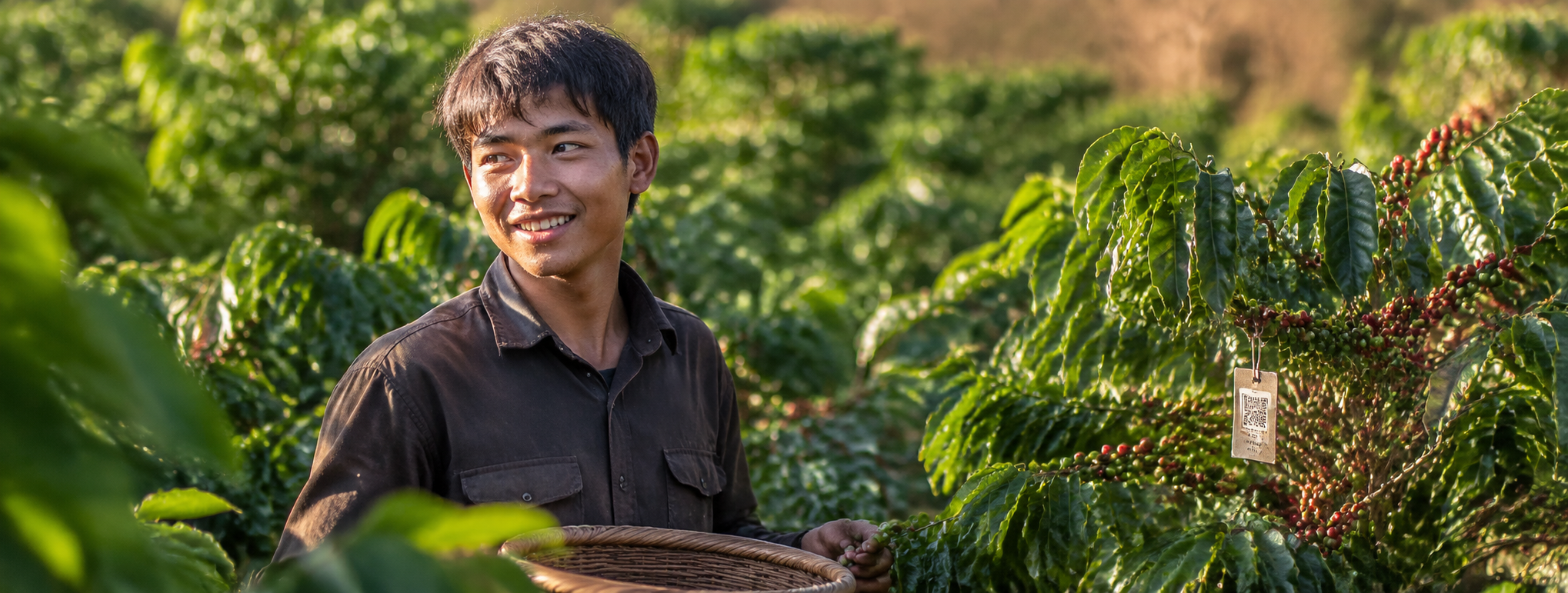
Y Bhim remembers clearly the day he planted his first coffee tree. He does not remember the year — people in his village do not store time that way — but he remembers that the early rains had just come, the soil was still damp from the night before, and his father stood behind him guiding each movement as though passing down something sacred. It was the late 1990s, when farm-gate prices for robusta beans were still high enough for people to believe that the Central Highlands were standing at the edge of a clear future. The tree went into the ground. So did the expectation.
Y Bhim is fifty-one now, sitting on the wooden steps of his house looking out over three hectares of robusta coffee entering their eighteenth year. The trees have aged like him, in a way — they started in a moment of optimism, weathered the same years, and have begun showing the kind of fatigue that nobody can quite name precisely. This dry season has lasted longer than any he remembers. March came and went without meaningful rain. He irrigates from a drilled well, but the water table has dropped nearly two meters lower than it stood at the same point last year.
The Central Highlands — the region that coffee turned into an economic identity over more than three decades — is undergoing a shift that people like Y Bhim feel in their bodies before any climate report puts it into language. The rainy season arrives later. When it comes, it comes in violent bursts rather than the slow, steady months of rain that once characterized the calendar. The dry season extends at both ends, reaching into November on one side and April on the other. Afternoon temperatures in March now regularly touch 37 to 38 degrees Celsius in areas that rarely exceeded 33 degrees in previous decades. Robusta — Coffea canephora — tolerates heat better than arabica, but not without limit, and not when an extended drought coincides with peak temperatures during the exact window when flower buds are differentiating.
Last crop year, Y Bhim harvested 8.4 tons of fresh coffee cherries across his three hectares. The number does not sound alarming from a distance, but measured against the 10 to 12 tons the same plot consistently produced between 2015 and 2019, it is a decline that has been compounding. Two years ago: 9.1 tons. The year before that: 10.2 tons. This year: 8.4 tons. The trend line in his head does not need to be drawn to be understood.
Farm-gate prices for unprocessed robusta hovered between 115,000 and 125,000 dong per kilogram for most of the past crop year — substantially higher than previous years, when prices sometimes fell to 35,000 to 45,000 dong and pushed thousands of coffee households into technical losses. The current price environment is real and welcome. But it masks a quieter problem: yields are falling, input costs are rising, and the margin between those two realities is narrowing at a pace that strong prices may not fully compensate for in the years ahead.
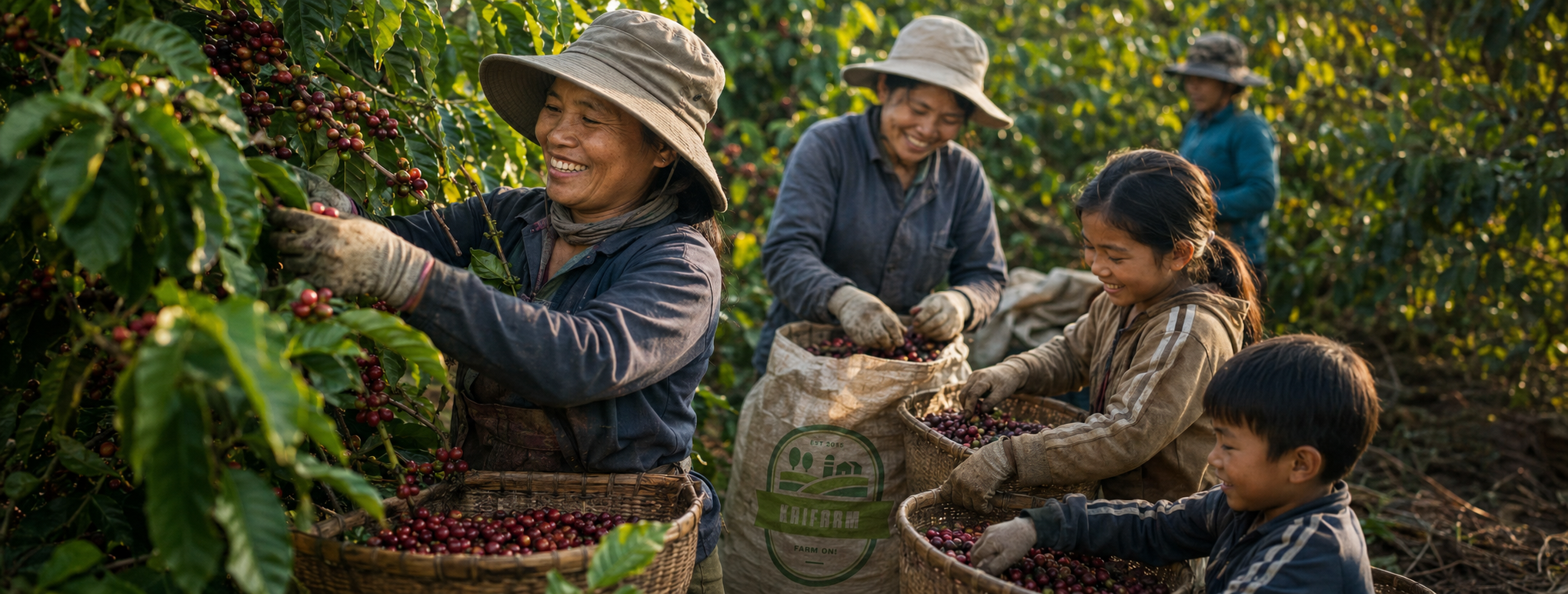
Y Bhim’s production costs last season came to roughly 95 million dong across three hectares: NPK and organic fertilizer accounted for the largest share at around 42 million dong; irrigation labor and electricity for the drilled well pump added 18 million dong — about one and a half times higher than three years ago, because the longer dry season now requires more irrigation cycles; fungicide and pesticide applications for pink disease and mealybugs ran approximately 11 million dong; and hired labor for the harvest came to nearly 24 million dong. Selling 8.4 tons at an average of 119,000 dong per kilogram generated gross revenue of roughly 999 million dong. After costs, approximately 904 million dong remained. The number looks acceptable on paper. It does not account for the depreciation of an aging garden, does not count the labor of his family, and does not include the contributions of his wife H’Wen — who woke before four in the morning every day for two months during harvest to prepare meals for the hired workers — and it does not reflect the 150-million-dong loan he has been repaying since a partial replanting in 2021.
The biggest question facing Y Bhim right now is not where coffee prices will go. The biggest question is water.
His drilled well is 68 meters deep, sunk in 2009 at a cost of around 22 million dong at the time. This dry season, the pump began drawing air during daylight hours — a sign that the water table had dropped below the intake level during peak demand. He shifted to night irrigation: running the pump from ten in the evening until three in the morning when the water level partially recovered, letting the well recharge through the day. This meant six weeks of broken sleep, and it also meant that portions of the garden still did not receive adequate irrigation at the right intervals. Trees that are water-stressed during flower bud differentiation will bloom unevenly, leading to uneven fruit ripening, leading to a longer and more labor-intensive harvest — a chain of consequences multiplying from a single deficit.
His neighbor, a Kinh settler named Hung who came from Binh Dinh Province to farm here in 2003, drilled a new well earlier this year — 90 meters deep, at a cost of nearly 65 million dong. The new well yields water, but Hung admits he does not know how long it will last, and he has no answer to the question of what happens when the shared aquifer beneath this entire area is drawn down by hundreds of wells simultaneously during an ever-lengthening dry season. This is the kind of problem each individual solves for themselves while no one solves it for the system — and the result is that every farmer acts rationally within their own reach while the collective trajectory moves in a direction nobody actually chose.
Y Bhim sat with a sheet of paper and a pen on an afternoon in April. It was not the first time he had done this, and it would not be the last. He was working through a decision he had postponed for two years: whether to replant all three hectares. An eighteen-year-old robusta garden is at the stage of irreversible yield decline — a biological reality of the species, not a consequence of poor management. Replanting with improved varieties — TR4, TR9, or drought-tolerant hybrid lines currently being recommended by extension services — could restore yields to 14 to 16 tons of fresh cherries per hectare under good conditions. But full replanting means three years of near-zero income from the garden, while the upfront investment in seedlings, soil preparation, and planting labor runs between 80 and 90 million dong per hectare — between 240 and 270 million dong in total.
He does not have that money. The existing loan is not yet repaid. Borrowing additionally from a policy bank at subsidized rates of around 6 to 7 percent per year — if the application were approved — would still carry a burden stretching across years in a situation where neither yield nor price can be forecast with confidence. The alternative was rolling replanting: clearing and replanting roughly one hectare per year, keeping the remaining two hectares productive to sustain cash flow. This approach stretches the transition across three years, reduces capital pressure, but also means that for the entire period, between a third and half of the garden is always in a non-productive or low-productive state. Every path has a cost. He underlined the figure 270 million dong, looked at it for a moment, then folded the paper.
He chose the rolling approach. Not because it was the agronomically superior option, but because it was the least risky option given his household’s actual circumstances — a distinction that agricultural extension models frequently miss when they offer technical recommendations without accounting for the specific financial reality of each farm family. Farmers do not make decisions on ideal spreadsheets. They make decisions inside a web of constraints — capital, labor, risk tolerance, time — and each constraint carries its own weight.
Y Bhim’s eldest son, Y Tuan, is twenty-three and working for a construction company in Dak Lak Province. He earns around 8 million dong a month — steady, independent of rainfall. When he visits, he helps on the farm for a few days and then leaves. Y Bhim does not ask his son whether he wants to take over the garden. The question, he senses, already has an answer that both of them understand without saying it aloud. Y Tuan is not refusing his father. He is simply living inside a different reality — one where a monthly salary, even if lower than farm income in a good price year, does not arrive and disappear with the rain, does not depend on the water table, does not require him to stay awake through the night watching a pump.
This is the generational shift unfolding quietly across the Central Highlands — not announced like a policy, not visible like a decision, but present in every household where the adult children are working somewhere else. Coffee gardens are not abandoned overnight. They age alongside their owners, managed through experience and habit for as long as the body allows, then gradually contracted, leased out, or sold when the next generation does not return. The process has no official name in any policy document, but it is reshaping the agricultural structure of a region where coffee was once the reason people came and stayed.
H’Wen talks about these things less than her husband does. She manages worry through work — a quality that outside observers can easily mistake for acceptance. She knows every tree in the garden the way that only two decades of daily attention produces: which ones are prone to mealybugs, which ones fruit consistently but ripen late, which ones stand in low ground that retains moisture and could therefore skip one irrigation cycle during this past dry season without significant damage. This is the kind of knowledge that does not appear in any agricultural textbook and is not captured in any yield survey, but it is precisely what has kept those three hectares functioning at an acceptable level during the years the garden has begun to decline.
May. The first rains of the season arrived after a week of clouds without rain — the kind of weather that coffee farmers in this region describe as the sky breaking its promise. When the rain finally came, Y Bhim stood alone in the garden without hurrying inside. He watched the water move along the furrows between the tree rows, soaking into the red basalt soil that had been dry and cracked for weeks. On the branches pruned back earlier in the year, small clusters of buds were beginning to emerge — slower than in previous years, more uneven than before, but there.
He does not know how long this rainy season will last. He does not know what the price of coffee will be in November. He does not know whether the well will hold enough water through the next dry season. What he knows for certain is less than what he does not know, and this has not always been the condition of coffee farming — there were periods, he remembers, when the uncertainty was smaller and the space it left was filled by expectation. Now the space is larger, and what fills it is no longer expectation but experience — the knowledge of how to keep going through a season that cannot be predicted, day by day, until the harvest comes and the question gets its answer, whatever that answer turns out to be.
The rain was still falling. He stood a little longer, then went inside.
KAIFarm® Team
People
People
Story
Story
Story
Story