The Weight of the Season: How One Woman’s Ledger Holds a Household Together at the Edge of Vietnam’s Cashew Belt
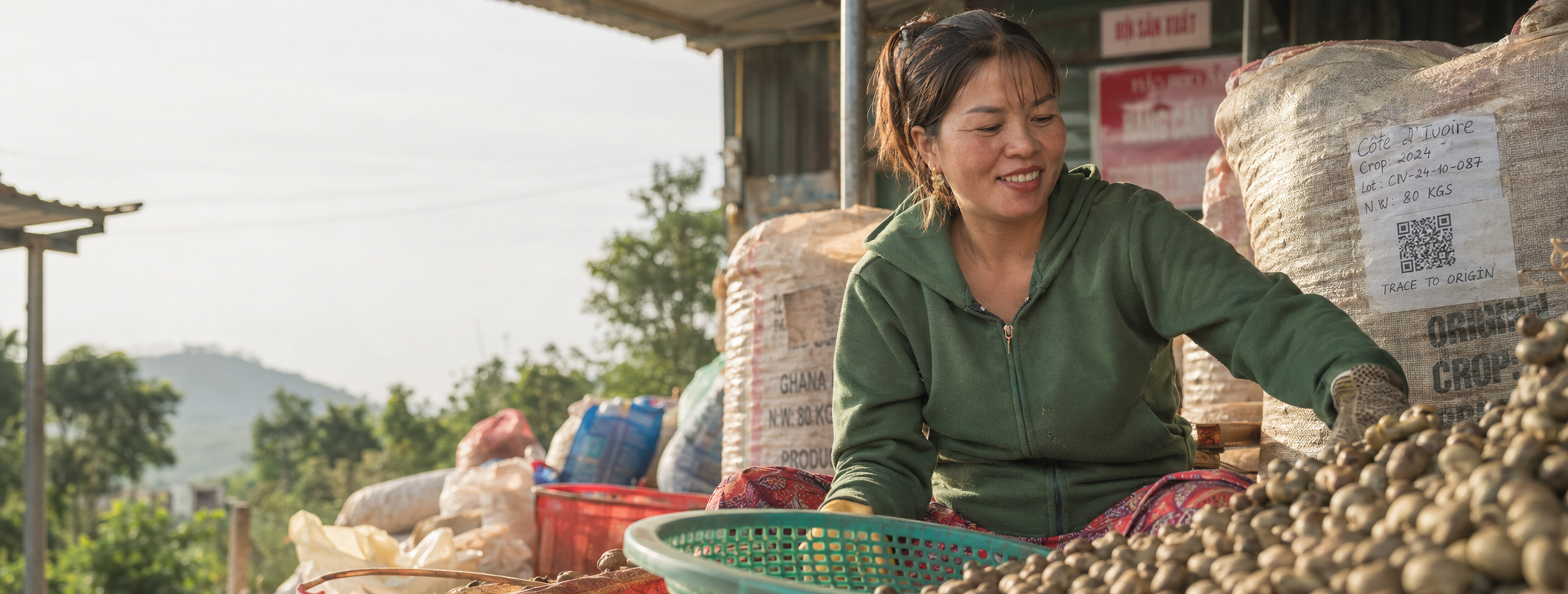
Nguyen Thi Lan does her accounting by lamplight. Not because the power is out — the single bulb above her table works fine — but because the habit formed years ago when it wasn’t, and some practices outlast the conditions that created them. She sits at the wooden table that doubles as a kitchen counter, a school desk for her youngest, and the one surface in the house wide enough to spread out a full season’s worth of handwritten receipts. It is late March in Binh Phuoc Province, the dry air still carrying the faint sweetness of cashew blossoms that have already fallen, and the reckoning has begun.
She is forty-three years old. Her husband, Minh, is in Binh Duong Province for the fourth consecutive year, working a construction job that pays around 350,000 dong per day when the weather allows and nothing when it doesn’t. Their oldest son dropped out of school at sixteen to follow a friend to a factory dormitory in Dong Nai. Their second child, a daughter of nineteen, stayed — out of duty or love or both, it is hard to say — and handles the heaviest labor during harvest season. The youngest, a boy of eleven, is asleep two rooms over. Lan manages the farm alone in all the ways that matter.
The farm is 1.8 hectares, planted with cashew trees that average fifteen years of age. It was her parents’ land, passed down without ceremony in the way rural land often transfers — through illness and necessity rather than inheritance planning. In a good year, she will harvest between 1.8 and 2.2 tons of raw cashew nuts per hectare, selling to one of the itinerant traders who come with motorcycles and scales during the April-to-June window. In a bad year — and the last two have both been bad years — she might pull 1.2 tons per hectare, sometimes less. The difference between a good year and a bad year is not dramatic in the telling but devastating in the living. At current farm-gate prices of roughly 28,000 to 32,000 dong per kilogram of raw cashew, the gap between 2.2 tons and 1.2 tons on her 1.8 hectares translates to a difference of roughly 54 million dong in gross revenue — over two million dong vanished from a household that has no cushion to absorb it.
Last year, she netted something in the range of 38 million dong from the farm after accounting for fertilizer, pesticides, hired labor for harvest, and the informal loan interest she owes a neighbor who covered her inputs two seasons ago. She will not call this profit. She will not call it income. When asked directly, she says it is “what remained,” and then she lists what it had to cover: school fees, a motorbike repair, three months of her husband’s phone credit so they could coordinate money transfers, and the purchase of a small electric pump for the dry-season irrigation that failed to save last year’s yield anyway.
The cashew tree is often described as a forgiving crop, suited to poor soils and irregular rainfall. This is technically accurate and practically misleading. What the tree forgives in soil quality, it does not forgive in timing. The flowering period — typically between December and February in Binh Phuoc — is exquisitely sensitive to moisture. A late dry spell that extends through flowering will abort the blooms. An unseasonal rain during pollination will wash away what would have become fruit. Climate irregularity, which farmers in this region describe not in the language of science but in the accumulating evidence of their own seasons — “it is no longer the same as before” — has turned the cashew’s tolerance into something more fragile. The last three years have brought erratic rainfall patterns that those who have farmed here for decades say they did not see in the decades prior.
Lan’s neighbor, a man named Phuc who farms 2.5 hectares about four hundred meters down the red-dirt road, switched two years ago to planting durian on half his land. He borrowed 120 million dong from a bank — collateralized against the land title — to finance the conversion: seedlings at around 150,000 dong each, irrigation infrastructure, and the cost of two years without significant income from that portion of the farm while the trees matured. He has told Lan several times that she should do the same. Durian prices in recent seasons have made some farmers in adjacent districts what passes for wealthy in this context — seasonal revenues that dwarf what cashew returns. But durian is an intensively managed crop. It requires precise irrigation scheduling, labor-intensive hand-pollination, calcium and boron supplements, and a level of technical input that demands either close attention or hired expertise. Phuc can manage it because he has two adult sons on the farm. Lan has her nineteen-year-old daughter and herself.
The calculation she has made, and remade, goes something like this. Conversion of one hectare to durian would cost her between 80 and 100 million dong in setup costs — a sum she does not have. Borrowing it from a formal institution would require a clean land title, which hers is, but also a loan officer’s confidence in her repayment capacity, which is harder to establish when the primary income-earner on paper is a husband in another province. Informal lending at the rates available in this village — typically 2 to 3 percent per month — would cost her between 1.6 and 2.4 million dong each month in interest alone before she had harvested a single fruit. The durian trees would not produce meaningfully for three to four years. She has done this arithmetic many times. Each time it arrives at the same threshold: it is a gamble she can only afford to lose if she has something to fall back on, and she does not.
So she stays with cashew. This is not resignation in any theatrical sense. It is the rational decision of someone who understands risk management intuitively, who knows that the certain loss of conversion costs plus years of interest outweighs the uncertain gain of a durian price that could, as she says flatly, “fall the moment everyone plants it.” She is not wrong about this. Commodity price collapses following investment surges are a documented pattern in Vietnamese agriculture, from coffee in the early 2000s to black pepper a decade later. Her skepticism is structural knowledge stored not in economic journals but in conversations with traders and the memory of what happened to the pepper farmers two districts away.
March is the month she calls “the long breath before.” The harvest has not begun and the inputs for the season are already spent. She purchased two bags of potassium fertilizer in January — about 420,000 dong each — and three liters of a fungicide she mixes herself from concentrate, which cost her around 180,000 dong. She hired a young man from a neighboring household for two days to help prune the lower branches, paying 200,000 dong per day. She has counted these costs in her notebook in a column she does not label but that functions as a ledger of things she cannot get back. By the time the harvest comes, she will hire three additional workers for approximately two weeks at the same daily rate, which adds another 2.8 million dong in outflows. The arithmetic is familiar to her the way a scar is familiar — something she has stopped feeling surprised by but has not stopped carrying.
Her daughter, Hoa, wakes before Lan most mornings. She handles the water pump at five-thirty, moves through the rows checking for the scale insects that have been spreading in the province — a relatively new problem, she says, that nobody here managed twenty years ago because twenty years ago the dry season was not quite so dry — and reports back to her mother with the sort of specificity that makes Lan’s ledger-keeping possible. Hoa does not appear in any official accounting of the farm’s labor. There is no line item for her. If you were to calculate the household’s actual labor costs at market rates, including Hoa’s daily hours during the pre-harvest and harvest months, the net income from the farm would look considerably worse than it does in Lan’s notebook. This is the arithmetic that agricultural surveys routinely miss: the unpaid family labor, disproportionately female, that subsidizes the apparent viability of smallholder farming.
Lan knows this in her body without having a name for it. When she says the farm “supports the family,” she means that the farm’s output, combined with Minh’s remittances — which total somewhere between 3 and 4 million dong per month in a good construction month — and Hoa’s invisible contribution, and her own management of every transaction and timing decision across the season, together produce a household that has not yet failed. This is a different statement from saying it thrives.
The evening I sit with her, she is trying to decide whether to sell early. A trader has approached her in the past week offering 26,500 dong per kilogram for a forward contract on her anticipated harvest — payment now, delivery in May. The price is below current spot indications, which hover around 29,000 dong, but the trader is paying cash today and cash today has a specific value in a household that owes a neighbor and needs to buy her son’s school supplies before the next term. She has taken forward contracts before. She took one three years ago at 27,000 dong and watched the market price climb to 34,000 dong by June of that year. The loss in counterfactual terms was significant — perhaps 12 to 14 million dong compared to what she would have received at peak price — and she knows this the way farmers know all their counterfactual losses, which is permanently and without use.
But she also remembers the year she did not take a contract and the price fell to 22,000 dong and she spent the following months repaying the input loan at an interest rate that compounded faster than the income she could generate. Holding out for the market price is a form of speculation that requires a buffer she typically does not have. The forward contract, at its core, is the purchase of certainty by someone who cannot afford uncertainty — and the trader, who can afford uncertainty, prices that service accordingly.
She does not make the decision that night. She closes the notebook, sets the receipts in a neat stack held down by a cup, and turns off the lamp. Through the open window, the cashew trees are invisible in the dark but their presence is total — sixteen years of her life shaped around their cycles, their needs, the specific rhythm of anxiety that begins in November when the first flower buds appear and does not fully release until the last bag is weighed and the trader’s truck pulls away.
Two days later, she takes the contract. Twenty-six thousand five hundred dong per kilogram, two tons anticipated yield across 1.8 hectares, partial advance paid in cash. She uses a portion to repay her neighbor. She sets aside 800,000 dong for her son’s school materials and a pair of shoes. The rest goes into a tin on the top shelf of the kitchen cabinet, earmarked — in her mind if not in writing — for whatever the next season will require before it gives anything back.
Hoa is in the field when Lan returns from meeting the trader. She does not come in for lunch. She has found a new patch of scale infestation on the eastern row and is treating it by hand with a cloth soaked in diluted insecticide, working methodically from tree to tree in the way her mother taught her, in the way her mother’s mother likely worked ground that is now parceled into roads and housing estates. The afternoon is very hot. The cashew trees offer some shade but not enough.
Lan watches her daughter from the edge of the field for a moment, carrying two bowls of rice wrapped in cloth. Then she walks toward her, and the season continues.
KAIFarm® Team
People
People
Story
Story
Story
Story